Fall slow down at feeders

Many of you have already noticed a slow down at your feeders.  Sometimes it can be abrupt and dramatic.  You may even notice some species become practically non-existent.  Bird feeders in September and October are typically very quiet. This is surprising to some but actually normal and understandable.  With the conclusion of the breeding season birds are now in less need of a quick, easy food source... your feeders.  While raising their young during the months of March through July birds expend tremendous amounts of energy and will take great advantage of backyard feeders.  We sell more seed and suet during those months than we do in winter. 

Now young birds are independent and the lives of adult birds are at a much more leisurely pace.  On top of that nature is producing an abundance of food at this time.  Not only are insects still plentiful but every tree, shrub, weed, and wildflower has produced seeds, nuts, and fruit.  There is literally food for birds everywhere.  It is a great example of the fact that birds do not rely on our feeders but simply take advantage of them in times of more demand for food.  So, don’t worry that you are not seeing many birds around the feeders right now.  It is totally normal. About the time we get the first frost or two, you will begin to see a return of your favorite birds to feeders.  I don’t know about you but a good frost sounds good right about now. 

And you will begin to see our winter visitors, like Junco’s, White-throated sparrows, Yellow-bellied sapsuckers, Kinglets, and hopefully, Purple Finch, Pine Siskin, and Red-breasted Nuthatch.

Keep this in mind while you are buying your seed next time.  It’s advisable to buy smaller quantities until birds begin visiting with more frequency in November.  Remember, the more seed you end up storing in a container over the next two months the more chance there is of having a bug hatch.   

And while birds take a break from your feeders take time to give your feeders a thorough cleaning.  Warm soapy water, a brush, and a little effort are well worth the effort to provide a clean, healthy feeding environment for the birds. 
The Hummingbird Wave is Coming

Soon hummingbirds will ramp up their interest in feeders and the action will be fast and furious.  August through mid-September is peak time for us to see hummingbirds at feeders.  Based on frequently asked questions at the store there's a lot of confusion surrounding Ruby-throated hummingbirds and the first few months they are here.  It is true Ruby-throated hummingbirds begin migrating through and into TN as early as mid-March.  This year the first reported sighting by a customer was March 30.  My first sighting was April 6th.  By the way, I've recorded first of spring (FOS) hummingbird sightings for over 20 years and it's always between April 3 and April 12.  And the first has always been an adult male. 

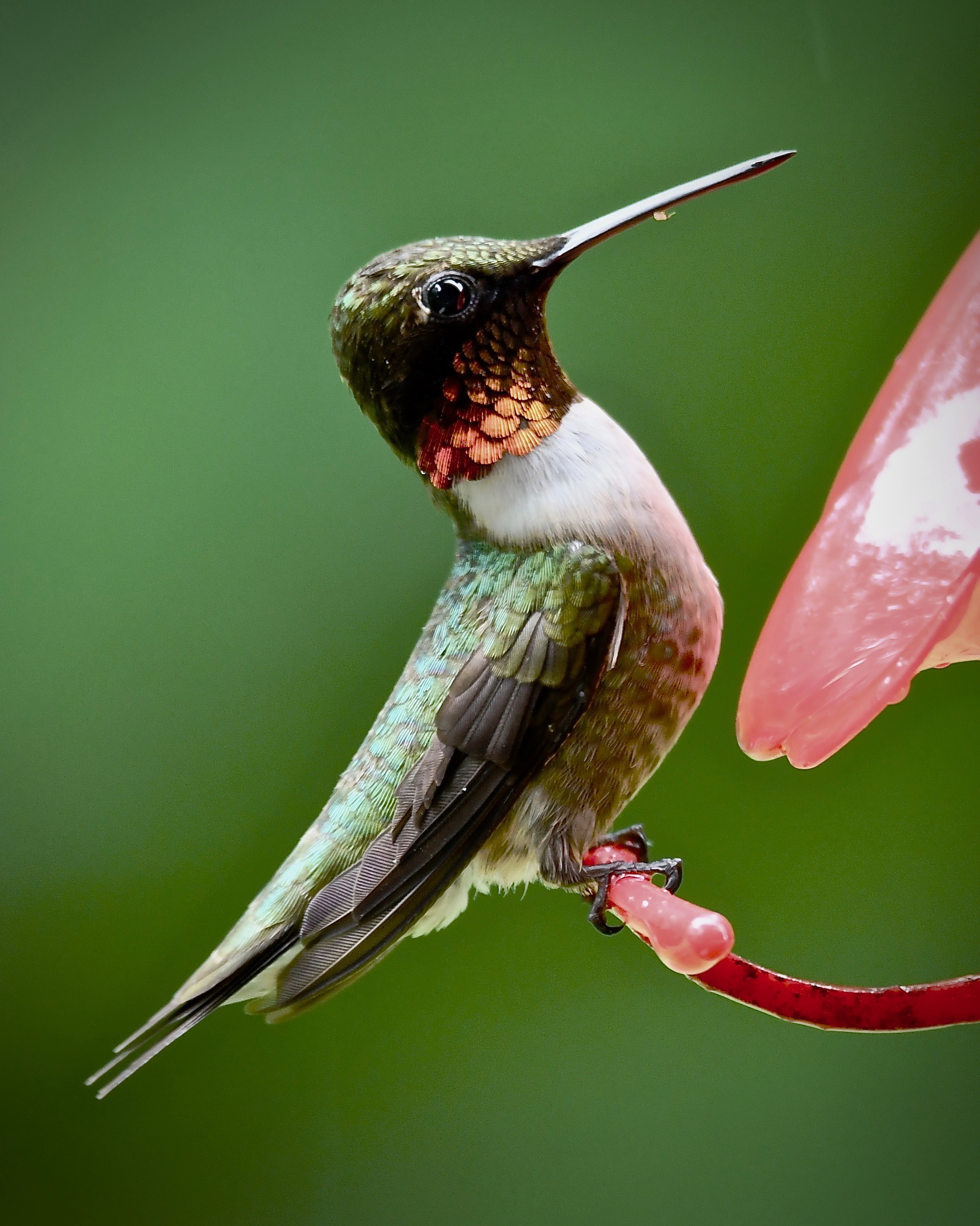
Occasionally we here a customer say "I have all kinds of different hummingbirds" when in fact they really only have one kind, the Ruby-throated hummingbird.  Only the adult male has the bright red throat while both sexes have an iridescent green back.  Adult females and juvenile's look very much alike but will vary somewhat in plumage.    

Although all Tennessee summer resident hummingbirds are here by mid-May, most people will see very little of them, and activity at feeders will be infrequent and minimal until at least early to mid-July when there is a sudden surge.

It is thought by many the reason for this sudden surge is they have just "come back" from where they've been.   Actually, it is that the summer resident hummingbirds have concluded raising one or even two broods of offspring and are ready to begin taking advantage of the free nectar in the feeders you've provided. Also, the added activity is indicative of recently fledged hummingbirds beginning to understand and visit feeders.  Then as we move into August hummingbirds that have been north of us, as far as Canada, will begin their migration south and stop at feeders along the way.  

It must be remembered hummingbirds don't travel all the way from central and south America because there are hummingbird feeders here.  They DO NOT NEED the feeders but will take advantage of them when they are ready.  Hummingbirds have been migrating here for thousands of years to breed and to take advantage of the abundance of insects, which is their primary food source.  They would come here even if hummingbird feeders did not exist.

Since hummingbirds feed on small insects there is an alternative to offering only nectar. Try placing some fruit in a mesh sack or container with holes, and hang it near your hummingbird feeder.  The fruit will draw fruit flies which the hummingbirds will readily devour.  It is quite interesting to see a hummingbird dart its specialized tongue out to snag the flies. Last year we introduced a new feeder called the Humm-Bug that is designed to hold fruit and draw fruit flies.  

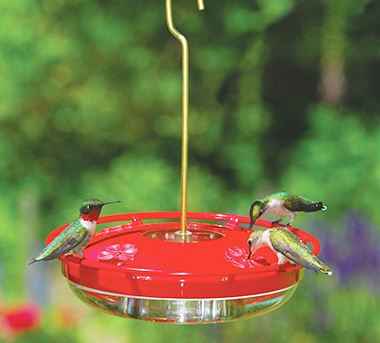
Aspects high view Hummingbird feeders are some of our favorite feeders. They are easy to clean, fill, and come with a built in ant moat. The high view refers to the new perch design which is raised up compared to older models. This helps keep the feeder from obscuring the bird while perching.

Hummzinger high view excel holds 16oz and has 6 ports.

Hummzinger high view feeders come in three different sizes. 8oz, 12oz, and 16oz.

Hummzinger high view feeders come in three different sizes. 8oz, 12oz, and 16oz.

Humzinger high view mini holds 8oz and has three ports.

Humzinger high view mini holds 8oz and has three ports.

Humzinger high view holds 12oz and has four ports.

Humzinger high view holds 12oz and has four ports.

Hummingbird Nectar

A question frequently asked at The Wood Thrush Shop is “what nectar is best for hummingbirds”? 

The best nectar you can offer hummingbirds is a simple 1 part sugar to 4 parts water solution.  It is not necessary for the water to be brought to a boil before adding sugar.  The nectar is ready after the sugar has been stirred in and fully dissolved.  Do not add color. Color is absolutely unnecessary and potentially harmful. When hummingbird feeding activity is slow, like it tends to be in early spring to mid-summer, make small amounts and avoid refrigerating large quantities.  Think in terms of making fresh nectar each week in small amounts until feeding activity becomes vigorous, like it does in the latter summer months.  This is when it makes sense to make larger batches and refrigerate extra nectar.  Remember, nectar in the feeder is only good for about 3 days in summer heat.  Fill your feeder according to the activity level and you will waste less nectar and reduce your maintenance on the feeder.  The peak time for hummingbird feeding activity typically starts mid-July and lasts through September, and even into October.

So, if you’ve been disappointed and concerned because you haven’t seen much of hummingbirds now is the time to make sure your feeders are clean and the nectar is fresh.  It’s going to get very busy!

Hummingbird Myths

Hummingbirds have "scouts".  Not really sure how this got started but likely because people would see an early arrival and then other hummers would eventually follow.  There is no way an adult male Ruby-throated hummingbird would actively help or encourage others to share "his" territory.  Everyone sees how territorial they are as they fight for the rights to a feeder.  It is believed an adult male can and will defend a territory of up to an acre.

Hummingbirds and Geese.  I haven't heard this one in a long time so hopefully it has gone away for good.  It was believed by some that hummingbirds would ride on the backs of larger birds, specifically geese, during migration.  This does not occur. 

Feeders must be taken down in the fall.  We still hear this one quite often.  People believe that hummingbirds will not migrate in the fall if feeders are left out.  Not so.  It is in their DNA to migrate.  Again, hummingbirds do not NEED sugar water, so why would an artificial food source keep them here?  If we had to take away all food sources to make them migrate we would also have to eliminate all of the various insects they feed on.  


Summer bird feeding challenges

It’s most definitely upon us.  The time of year when many of you are faced with challenges certain backyard visitors present. They can really test ones patience. I’m talking about Grackles and Starlings, Raccoons, Chipmunks, and Mountain Lions.  Well, maybe not Mountain Lions.

Your bird feeders are of great interest to all afore mentioned birds and animals largely due to this being the breeding season.  I did not mention squirrels because we deal with them every day.  The others are more of a seasonal issue.  One thing worth mentioning about squirrels is they are more likely to eat safflower during this time. We’ve already heard from a few of you that squirrels have decided to start eating safflower when previously they did not.  Usually it’s the young squirrels that eat safflower.  This too shall pass.

When Grackles and Starlings are on the nest they seek quick, easy food sources and will visit in droves bringing their babies as well.  We recommend a variety of strategies to lessen their impact:

  • Offer nothing but Safflower seed rather than sunflower or blends with shelled seeds, shelled peanuts, and fruit.  Safflower is smaller than sunflower and has a different shape, and a hard shell that Grackles and Starlings cannot crack open. 

  • We also suggest shutting down the feeders for a while, perhaps a week or two.  This can cause these sudden intruders to move along and be someone else’s problem.  Usually the Grackle/Starling pressure recedes by mid to late June when breeding is over.  The other birds you want will typically return to the feeders in no time.

  • Limit opportunities and any opportunities available should be difficult for a large bird like a grackle to use.  For instance, small bird only or caged type feeders.  Yes, this will also limit Cardinals but they would be happy to feed on whatever falls to the ground.  If you have a tube type feeder with straight perches consider cutting them in half.  They are usually made of aluminum and easy to cut.  Half a perch will present great difficulties for a Grackle and Starling but your small birds will use them easily.

  • Suet is a favorite food source during this time because it’s soft and easy to take large chunks.  Again, removing the food source for a week may cause the problems to move on.  Another thing to try is take note of the timing of their visits.  You can offer smaller amounts of food, like a third of a suet cake at a time, so your desired visitors have a consistent food source for part of the day. When the problem visitors show up there is little food remaining. 

  • Squirrel proof suet feeders are very effective at keeping squirrels out but not always the Grackles.  Only the largest Squirrel proof suet feeders provide enough distance between the food source and the outer cage to stop Grackles and Starlings.

Next to Grackles and Starlings there’s a tie for most complaints between Raccoons and Chipmunks.  Raccoons are expert climbers, they have great dexterity in their paws, which are really like hands, they can grow to be quite large, and their strength and brain power far exceeds that of a squirrel.  Many of you find your feeders on the ground in the mornings damaged with squirrels gathered round feasting on the exposed seed.  This is a sure sign that a raccoon has been working the night shift as they are mostly nocturnal.  They will take feeders off hooks and hangers with ease, take the lids off and eat until they are satisfied.  Here are some suggestions for reducing raccoon problems:

  • Bring in feeders at night that are accessible to raccoons.  It may take a few weeks to condition the raccoon to not to show up.  After a few weeks try leaving a feeder out one night to see if they have gotten the idea that no food would be available.  Continue taking the feeder in if you see evidence they’ve been there.

  • The “limited amount” strategy works well here, too.  If it’s suet they are getting only put a third or half a cake in the feeder. By nightfall when the raccoon shows up there would be little if anything left.   

  • Raccoon baffles for pole systems, which are much larger than squirrel baffles, are very effective.  Follow directions and you will have success.  A squirrel baffle will not likely stop a motivated raccoon. 

  • This is not my favorite strategy but some people will make food available in places away from feeders.  They might offer table scraps, corn, or cat food to satisfy the raccoons.  I see evidence of raccoons getting in my compost pile where I put everything from coffee grounds to old fruit and vegetable scraps. In my opinion this strategy just encourages their desire to visit.

Chipmunks are challenging in that they can squeeze through caged squirrel proof feeders and they are usually not heavy enough to activate a weight activated feeder.  And they like safflower.  However, any squirrel baffle will stop them cold. 

Be patient.  We need to try and be tolerant of wildlife even when they are pesky. 

Feeding bluebirds

Everybody would like to attract Bluebirds.  The fact is it is not difficult to attract Bluebirds and the single best way to do that is with a couple of nest boxes placed in good locations as we pointed out in last week’s blog.  We want to help you attract Bluebirds and enjoy the entire experience from courtship to nest building, egg laying to chick development, and finally fledging.

Besides the nest boxes planting native berry producing trees and shrubs, like Dogwood and Beautyberry for example, have a consistent source of water, and offering an appealing food source like live mealworms are things that will help.  Eastern Bluebirds feed primarily on insects and berries’ so feeding them is different than the way we feed other birds.  At The Wood Thrush Shop we have a great deal of experience feeding Bluebirds and would like to pass on our tips and tricks to help you have success and enjoy the activity as much as we do. 

In the spring when Bluebirds begin checking out a nest-box is the best time to begin offering the live mealworms.  Why?  Their need for nest boxes takes precedence during the breeding season and will bring them to your yard more predictably and reliably, and potentially for several months.  Feeding them then becomes a lot easier.    

Caged type bluebird feeders help discourage larger birds from accessing mealworms.

Caged type bluebird feeders help discourage larger birds from accessing mealworms.

We stock lots of simple tray and dish options that work well for feeding bluebirds.

We stock lots of simple tray and dish options that work well for feeding bluebirds.

These small glass dish type feeders come in a veriety of styles such as hanging, garden stake, and pole mount.

These small glass dish type feeders come in a veriety of styles such as hanging, garden stake, and pole mount.

Once you see Bluebirds showing interest in a nest box be prepared to offer mealworms.  The type of feeder to use is really not very important.  My choice of feeder is a small clay dish which is placed on a large rock which is easily seen from the top of the nest-box, just a few feet away.  Platform type feeders tend to work very well, too.

Look for an opportunity to walk out to the feeder and offer a small amount of worms, maybe a dozen.  THIS IS IMPORTANT!  The key is to make sure the Bluebirds are there to see you make the offering. 

After placing the worms in the feeder walk away and watch.  In most cases you will have immediate success.  They fly right down to the dish and gobble them up.  I like to repeat this after they consume the first offering just to reinforce the process.  I repeat this little scene every time the opportunity arises over the course of the next few days or weeks.  Usually 4 or 5 times are enough for the Bluebirds to catch on to what you are doing.  If during that first offering they fly away do not leave the mealworms there.  The longer the worms are there the greater the likelihood that other birds, like Robins, Mockingbirds, or Starlings see them.  If they catch on to this offering feeding the Bluebirds will then become almost impossible, not to mention possibly creating enough conflict the Bluebirds may look elsewhere to nest. 

Repeated successful feedings will help get you bluebirds on a "feeding schedule".

Repeated successful feedings will help get you bluebirds on a "feeding schedule".

When bluebirds show interest in your nesting box is the best time to offer food.

So, keep the offerings minimal until the Bluebirds really catch on.  Then you can increase the amounts of mealworms being offered as they raise their young.  Soon they will be waiting for you, or even seeking you out in your yard as I’ve experienced in the past.

TIPS For Feeding Bluebirds:

Ø  Offering mealworms when Bluebirds are not present is a sure way to feed a lot of other birds.  Wait until you see them before offering.

Ø  If birds that you do not want are getting the mealworms suspend offering the mealworms for a few days or more and start over using the suggestions we’ve outlined.

Ø  Bluebirds may partake of other foods like dried mealworms, suet, Bluebird nuggets (a type of suet), raisins, blueberries, chopped apple and grape.  Experiment and let us know your results.

Ø  Location is important.  Don’t try to feed them near birdfeeders or a place that gets a lot of bird traffic.  Feeding them close to their chosen nest box is easiest but do make sure you don’t let other birds in on the mealworms treat.  Some birds may become territorial over the food source and create conflict at the Bluebird box. 

Ø  Some people employ the method of making a sound, like whistling, while they offer the worms.  Like Pavlov’s dogs, Bluebirds will key in on the sound and associate that with the treat about to be given them.  I’m convinced that the Bluebirds we fed behind the store one year became familiar with the sound and sight of my truck arriving in the morning.  As soon as I would get out of the truck they would be landing on nearby perches waiting for me to enter the store and bring out worms.

Remember, Bluebirds will not become dependent on the mealworms but will simply take advantage while they are offered.  You can suspend feeding Bluebirds any time and not worry that they will starve. 

Get ready for bluebirds

Have you been watching and listening?  Birds are singing and going through the motions of courtship. The breeding season is fast approaching.  It’s evident Eastern Bluebirds have already begun searching for mates and potential nest-sites.  Several times in the past few weeks I’ve seen multiple Bluebirds land on and look in the nest boxes around my yard. (See video) In the video you will see classic courtship behaviors like wing fluttering. 

Although most Bluebirds won’t begin their first nesting until early to mid-April, their search for nest sites will typically intensify in the last weeks of February and into March.  Some eager Bluebirds may get on nest as early as mid-March.

You may think you don’t have the right situation for Bluebirds because you’ve heard they need the perfect setup to be attracted.  Not true.  Bluebirds adapt very nicely to all kinds of yard situations.  If Bluebirds needed the “perfect setup” as described by the many articles you may read about them they would be extinct by now. Offer a couple of nest boxes in good locations and see what happens.  If you already have nest boxes now is a good time to make sure they are cleaned out and free of old debris left over from last year’s nesting’s.  

Here are a Few Tips on Choosing a Location:

Ø  An open lawn area may be preferable but not absolutely necessary.  Choose the most open location available in your yard even if it means there will be a little more human traffic. 

Ø  Bluebirds are typically more sensitive to a lot of bird traffic, so it’s not recommended nest boxes be placed near bird feeders.  What’s a comfortable distance?  It’s impossible to be exact but we would suggest 50 to 100 feet away, or out of sight of feeding stations.

Ø  You may have heard that nest boxes need to face east.  While this may be helpful to keep wet weather from being a detrimental factor this is not something Bluebirds require.

Ø  A Bluebird box does not need to be on a pole, although the advantage of a pole is it allows you to position the box in the location you determine to be the best.  Bluebird boxes can be mounted to trees, fences, structures like garden sheds, and utility poles.  A height of 4’ or 5’ is sufficient.   Our pole system for Bluebird boxes will put the box at 5’ after installation.

Ø  How many boxes can be offered in a typical yard situation?  So, there is no harm in offering lots of nest boxes (birdhouses) in your yard but do not expect them to all get used at the same time especially if they are close in proximity to one another.  For instance, two nest boxes within 25 feet of one another are not likely to be occupied simultaneously.  Birds are too territorial to accept this situation unless they are colony nesters like Purple Martins and Cliff Swallows.  But feel free to decorate your yard with lots of birdhouses if that’s your thing.  Offering multiple nest-boxes is great and it does lessen the competition for a single box but  do consider the nature of the species you are trying to attract and what kind of setting would be most appealing.

Ø  We are often asked “when is a good time to put up a bluebird box”?  Every day is a good day to put up a bluebird box.  After all, the sooner they see it the better the chances are of attracting them.

And PLEASE, PLEASE, PLEASE remember to not let your desire to attract Bluebirds cause you to clean out other songbird’s nests like Chickadees, Wrens, the Tufted Titmouse or White-breasted Nuthatch. In no way does cleaning out a Chickadee nest ensure you will get Bluebirds instead.  Chickadees typically nest earlier than Bluebirds and only once. Bluebirds will nest up to 3 times per season and have plenty of time.  Even if you do not get Bluebirds during the first nesting there is still time for two more.  Besides, if a Bluebird wanted the nest-box it would easily out-compete a Chickadee.  Enjoy the fact that you’ve attracted a native songbird to your offering and watch the process.  It’s a lot of fun.

….Next Week How to Feed Bluebirds