
BIRD NEWS BLOG
House Wren Competition
After our blog about “dealing with predators and problems” appeared last week we received a couple of comments about House Wrens (HW). One comment referred to the HW as a predator. Technically the HW is not a predator but a competitor, and has been known to pierce eggs and even kill baby birds in the nest box. They also have the unique behavior of filling up several available boxes with their nest material with no intention of using those nests. These are known as “dummy nests”. This is an interesting dilemma because the HW is a native songbird and must be treated as such.
The House Wren is not a year round species, like the Carolina Wren, and tends to first appear in this area around mid-April. They are fairly common but many of you will never see one in your yard. In 28 years at my home I have never included the House Wren on my “yard bird” list.
HW’s use almost exclusively sticks for nest building so when monitoring your nest boxes this is an easily identified nest. Any advice we can offer to help keep HW’s from doing what they do may “backfire”. Offering more choices of nest boxes can alleviate “pressure” on the one or two already present but may encourage more HW activity. Spending a little time monitoring your boxes can help. For instance, if you find sticks in a nest box where Bluebirds have been building a nest you may remove the sticks. Don’t just drop them on the ground because HW’s will just retrieve them and put them back. Or as we suggest with House Sparrows plug the entrance hole to a box for a while if you see HW activity.
An interesting strategy to try if you have experienced HW issues is the wren guard. The wren guard disguises the entrance hole. (Click here for a more in depth look at the wren guard). The wren guard is best used after a Chickadee or Bluebird, for example, have already fully committed to a nest by laying eggs.
It’s good to remember competition among birds for nest sites can reveal some difficult things about nature.
We hope this helps some of you and next week we will spend a little more time on monitoring Bluebird boxes. Please keep the questions coming. We enjoy being able to address things you want to learn about backyard birds.
Attracting Bluebirds: Dealing with Predators and Problems
Last week we invited you to ask questions you may have about Bluebirds, or any backyard bird subject. Trish Bolian asked us to show the difference in a Bluebird nest and a House Sparrow nest. And because Chickadees often use nest boxes we will show the 3 nest comparison. Thanks, Ms. Bolian.
Unfortunately for nesting birds here in mid-TN there are a number of predators and pests that can deter, disrupt, or destroy an attempt to nest. It’s no different for Bluebirds.
The most common problems are the House Sparrow, Raccoons, and Rat snakes.
The House Sparrow is perhaps the most common and frustrating to deal with. This introduced tenacious species is particularly noticeable in spring when the nesting season kicks in to high gear. You see them busily building nests in some of the most unlikely places, car washes, in traffic lights, gaps in broken store signs, Home Depot rafters, and in gaps or openings in just about any fast food restaurant. They may suddenly appear in yards and show interest in a nest box. Their nest is course, sloppy, and may contain debris like candy wrappers, cigarette butts, feathers, and odds and ends. These birds are highly motivated and typically get started in early March. House Sparrows have been known to pierce bluebird eggs and/or physically remove them from the nest. And in many cases they will fight the adult Bluebirds, sometimes putting so much pressure on them they decide to abandon. We have seen examples of adult Bluebirds being killed by these violent confrontations. So, what can be done? There are both passive and aggressive techniques that can be employed. The one you choose may depend on your level of past experience with House Sparrows. And we encourage you to under no circumstances allow a House Sparrow to use any of your nest boxes.
Ø If House Sparrows (HSP) begin showing interest in your Bluebird (BB) box by landing on and entering act quickly and plug the entrance hole to deny further access. Given a few days or a week of denied access the House Sparrows may become extremely eager to nest and look elsewhere. Repeat the process if they show up again. We see little evidence of BB nesting in early March but more likely early to mid-April. Be patient. Even if the BB shows up and looks at the box resist the temptation to unplug it, especially if the Sparrows have recently been there. After a few days of not seeing the HSP unplug the box and monitor for possible return. Be more patient than them and you just may win the battle.
Ø You may also pull out HSP nests and destroy eggs. Again, if this does not fit your philosophy at least plug up the box. Just don’t let them have it.
Ø We have two different Sparrow traps that can be effective. The Van Ert Sparrow trap is one that mounts inside the box and has a spring loaded mechanism that releases a door quickly closing the entrance hole thus trapping the bird inside. Pros and cons: this is a trap you should be monitoring frequently. It is best used if Bluebirds have not been present, only Sparrows. It is perfect for catching a Sparrow that has already begun nest building. After installing the trap use the Sparrows nest material taken from the box and drop it on the ground below the box. Sparrows will almost certainly go to that nest material and attempt to put it back in the box. Perfect. They go in trip the mechanism and will be caught as indicated by the bright orange marker displayed in the entrance hole. Just releasing them will put you back to square one. Relocating probably requires up to 10 miles. Relocating is not recommended and technically violates laws on transporting wildlife. The other option is to dispose of the bird. This is a touchy subject and one to be considered and decided by the individual. House Sparrows have been heavily factored into the beginning of the decline of Bluebirds many years ago. They are an introduced, non-native species therefore unprotected by law.
Ø Contraptions like the Magic Halo works quite well although we’ve seen HSP’s totally disregard it at times. The only place I’ve seen the Magic Halo available is on Amazon. The problem with the Halo is it is difficult to adapt to a bluebird box. For some reason it was made more with intent to keep Sparrows off bird feeders. The basic idea of the Halo is to create a vertical column of monofilament (fishing line) around the box. These are relatively easy to construct and one can use materials around the house to improvise. HSP’s are visibly bothered by the contraption and are reluctant to land on the box or go to the entrance, but not Bluebirds. Another contraption you may see is called the Sparrow Spooker. I am less confident in this one because I have no practical experience with it. Anything is worth a try when it comes to discouraging HSP’s. For more information about discouraging HSP’s visit the North American Bluebird Societies (NABS) website at www.nabluebirdsociety.org and Click here to visit their page on House Sparrow control.
Above all before taking action please positively identify the bird going into your nest box. Be sure it is a House Sparrow. Any other native species should be welcomed and have a chance to use the box.
Raccoons and Rat snakes are formidable predators and can be dealt with in much the same way. Raccoons are intelligent and great climbers, and Rat snakes are supreme climbers. Not all of us presenting Bluebird boxes will encounter these two but if you experience regular and on-going visits from Raccoons at your bird feeders we would encourage you to employ a Raccoon baffle on a pole to protect your Bluebird box. We carry baffles that will fit a metal pole up to 1 ¾” diameter, and wood posts up to 3 5/8” (todays 4x4). It should be noted a squirrel baffle may or may not stop either one of these predators. YouTube is loaded with videos of raccoons negotiating around a squirrel baffle.
Box placement has proven to be a factor, too. My 10 box Bluebird trail in a field has had no predation by Raccoons in many years of service. Boxes placed more in field and meadow situations tend to see less raccoon activity. Boxes placed adjacent to woodland and stream environments tend to see more. In this situation placing a nest box on a tree is not advised. This goes for rat snakes, too. A good raccoon baffle should stop both raccoons and rat snakes the vast majority of the time. For do it yourselfers you may want to check out the National Bluebird Society website for plans on PVC baffles and other critter stopping hardware and tips. Click here for NABS Predator control page.
Cats account for the majority of damage to bird populations in general. If you have a cat that is mostly outdoors and does a lot of hunting please reconsider this practice, but also we would recommend not having birdhouses or feeders until such time that you no longer have a cat. No guard or baffle stops a cat and most of the time a cat is waiting for its prey on the ground. Bluebirds are primarily ground feeders and become an easy target.
We can’t protect Bluebirds from every possible dangerous scenario in nature but it’s been through efforts of homeowner and Bluebird organizations that Bluebird numbers are strong today. Through a thoughtful and common sense approach to placement of boxes, observation, and monitoring we can continue to help Bluebirds thrive and enjoy being a part of the process and their success. As always we are available for on sight consultations and in-store recommendations.
Wet weather woe's?
Hello all,
It looks like another interesting weather weekend to hunker down and keep an eye on birdfeeders. All this wet weather does create some issues, however, that we would like to offer some prevention and maintenance tips for.
Mesh feeders like a shelled peanut or nyjer feeder are particularly troublesome in wet weather. As are feeders containing shelled sunflower. Such feeders really do benefit from a weather guard. The more rain you can keep off the feed the longer it will stay in good condition for the birds to consume and reduce your need to clean out clumped, rotting food. Yuck! Really wet feed is unpleasant to deal with.
Wire mesh peanut feeder with weather guard.
Aspects seed tube with weather guard and tray.
But even regular tube type feeders can collect moisture that settles to the bottom where a wet mess can turn into an unhealthy situation for your birds. Be a little more vigilante of feeder conditions at this time. Avoid refilling your feeder when there is a mass of wet clumped seed at the bottom. Weather guards of one kind or another can benefit tube feeders as well. And squirrel baffles serve well as weather guards. They are usually just larger versions of a weather guard.
Some feeders, like Aspects brand, have a very convenient push-button release base that allows you to clean out caked wet seed from the bottom in just seconds.
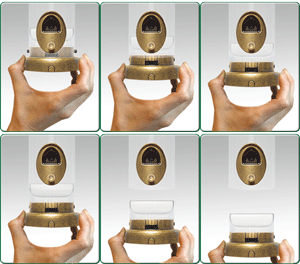
Aspects quick release base.
Clorox wipes are very handy for cleaning around feed ports. When the whole feeder isn’t ready for a cleaning just a quick wipe where the birds actually feed is very helpful to prevent unhealthy conditions.
If you have a platform feeder be very conservative about filling it in wet weather. Being totally exposed to the elements any seed out of the shell will deteriorate quickly. In the shell seeds are generally fine as long as the platform feeder has ample drainage, like a screened bottom. When I anticipate a period of rain I avoid adding any more seed to the platform feeder until the rain subsides. And before I refill it I use a putty knife, or old spatula, to quickly remove wet shell remnants.
If your tube type feeder has a tray the accumulation of shells and moisture can clog the drainage holes. Wiping the shell remnants out is easy enough using paper towels or a rag. Toothpicks are handy for cleaning out the drainage holes. And as always a good birdfeeder brush is essential to give tube feeders a deep cleaning. Warm soapy water is usually adequate but if you’ve let your feeder get really bad a mild solution of bleach and water and a few hours soaking might be necessary.
None of us really like cleaning our feeders but it really is a good and necessary thing to do if you enjoy this wonderful hobby. We hope some of these suggestions help and keep thinking sunny thoughts. The sun is bound to come back out sometime.
Product profile: Popular Nikon binoculars

This week we are profiling our most popular binoculars. Perhaps your old binos just aren’t providing you with a sharp, bright image anymore, or they’re out of alignment. Maybe your significant other has mentioned needing a pair of binoculars for hiking, birdwatching, canoeing, or ball games. Come in and let us assist you to determine which ones would be best for your needs.
Nikon Monarch 7
The Monarch 7’s are our top of the line stocked Nikon binocular.The 7’s are equipped with premium ED (Extra-low dispersion) glass, lenses, and prism coatings. ED glass improves resolution and brightness to extreme levels, but also enhances your viewing experience with a wide field of view, close-focus and comfortable eye-relief.

Customers that look through these usually say, “Oh, wow” because of the extremely bright, clean and crisp image. They are fantastic performers in low light conditions and have a nitrogen-purged housing making them fog proof/waterproof. These binoculars would satisfy for a lifetime. We stock the 8x42 and the 10x42. Available to order are the 8x30 and 10x30 models.
What do the numbers, 8x42 and 10x42, mean?
The first number that you see (8, or 10) is the amount of magnification. So, for example, an 8 power binocular is magnifying the object you’re looking at 8 times.
The second number (42) is the measurement of the objective lens, 42 mm. The objective lens is the lens furthest from your eyes, while the ocular is the lens closest to your eyes. The objective lens is the light gathering part and influences the field of view.
Field of view is how wide an area is encompassed in the binoculars' image. It can be expressed as an angle (8°), or as the width in feet of the image at 1000 yards (420 ft.) ... Field of view is a matter of eyepiece design. More magnification usually means a narrower field of view.
Monarch 5
The Monarch 5’s have been a staple of The Wood Thrush Shop’s optics inventory for many years. In quality, they are just a notch below the 7’s and lack some of the extra features. The 5’s have ED glass producing a bright, crisp image. They have been recognized in birding magazines many times as a “best buy”.

Also waterproof/fog proof, the 5’s offer some of what the more expensive binoculars have but in a more comfortable price range.
Prostaff 7
The Prostaff 7’s fit the difficult category of good optics, whether for home, out in the field birdwatching, or going to a game, at a price under $200. Multi-coated lenses, long-eye relief, and waterproof up to 3 feet of depth for 10 minutes.
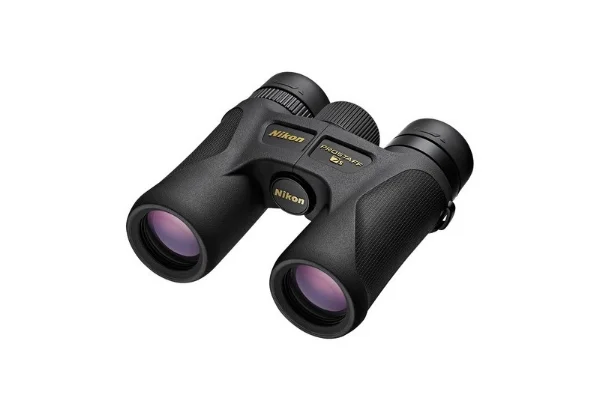
The shop stocks the 8x30, 10x30 and also the 8x42 and 10x42 sizes. The 30mm size is not as physically small as a compact, but close. They perform, however, like a standard size binocular. Because of the smaller body these binoculars have become a popular choice for women who tend to have smaller hands. A binocular that is comfortable to hold is a very important factor.
Long-eye relief defined. This is a term that every eye glasses wearer should pay attention to. It's all in the design of the eyepiece. For any binocular, there is an ideal distance that your eye should be from the eyepiece. This distance is called the eye relief. Some binoculars have eye relief of only 15mm or less. Even though the eyecups twist down to let glasses wearers get closer, it's not close enough. Such binoculars are suitable only for people who don't wear glasses.
Exactly how much eye relief you need depends on your glasses. If they are small and close to your eyes, you might get away with a binocular whose eye relief is only 15mm. Most glasses wearers need longer eye relief than that, at least 16mm or more.
Prostaff 3
The Prostaff 3’s are available in 8x42 and 10x42 models. Known for a wide field of view, being very lightweight, and having a generous eye relief, the Prostaff’3’s fit the consumer looking to spend under $150. Other features include waterproof/fog proof performance, turn and slide multi-click eyecups to fine tune comfort, and rubber armoring for shock resistance.

We stock compact binoculars as well. The Nikon Travelite’s are known for extremely light- weight portability and are available in 8x25 and 10x25 models. The Prostaff ATB are also 8 and 10x25 and are rugged and waterproof. The Trailblazer 8x25 is the smallest of the compacts but is rugged and waterproof, perfect for tucking in a coat pocket or day pack. It comes with a carrying case that conveniently threads onto a belt.

Trailblazers 10x25

Travellite 10x25

Prostaff ATB 10x25
Carson 8x22
And the best thing we offer for kids is the Carson 8x22 Sport Binocular. Most “kids” binoculars are so cheaply constructed with cheap materials that they are priced from $10 to about $20. From our experience with such binoculars any child is going to have a frustrating experience trying to see anything with them. And what they see will not be enhanced at all.

These little Carson’s are great for small hands, easy to use, and the optics are good enough that the image will enhance the object of their viewing interest. These are great to learn on before graduating to something more serious and valuable.
Attracting Warblers
Fall is a Great Time to Garden for the Birds
Fall is the best time to plant and perhaps you are thinking about adding something to your landscape that appeals to birds and wildlife. Fantastic! Adding plants is a great way to attract birds of all kinds but especially those that do not regularly visit seed feeders. I’m referring to the small tropical birds known as Warblers. This diverse and beautiful group of birds goes unnoticed by many backyard birders because their yards don’t have the habitat appeal necessary to pull them in. Each spring Warblers migrate into and through TN on the way to their breeding destination. As they travel they are searching for food, water, and suitable, safe resting areas.
Native trees and shrubs are critical to attracting birds of all kinds and especially warblers. Native plants attract native insects, an important food source to migrating birds. In spring when leaves are first opening the first caterpillars begin hatching which is an abundant and important food source for all migrating birds. In early fall native trees and shrubs are producing fruit that will help fuel their migration back to the tropics. The fruit also attracts native insects which then become an important source of protein. You can’t go wrong planting natives because they are, typically, less susceptible to disease and insect problems.
Here’s a short list of some of my favorite native plants and shrubs:
Serviceberry Bottlebrush Buckeye Devils Walking Stick
American Beautyberry Redbud Dogwood
Hawthorn Persimmon American Holly
Winterberry Eastern Red Cedar Mountain Laurel
Sumac Oak and Maple varieties Viburnums
…and there are so many more great plants to choose from.
But Warblers need water, too, and from my experience water is the x factor. It is probably that my water source is very easy to see from in my home that I have seen more Warbler species there than anywhere else in my yard. Bubbling, moving water is much more appealing than the standard pedestal type birdbath. Keep the water moving in some way and birds will be drawn. There are drippers and misters that run on water pressure provided by a standard outside faucet, and waterfall rocks powered by an electric pump that are quite effective at keeping water moving. I recently hung a plastic jug with a pin hole above a standard pedestal birdbath. When filled with water the jug will provide a steady drip for a few hours at a time. The dripping and subsequent rippling effect is absolutely more appealing than a still source of water.
So, if making your yard more appealing to birds is on your mind think about native plants and water. It is a combination that most definitely works.
For more information about native plants please take a look at the TN Native Plants Society website, www.tnps.org, or check out a local grower like Growild located in Fairview, TN. Their website is www.growildinc.com