
Get Ready for Bluebirds

In the coming weeks we will be sharing information about Bluebirds. We would like to address specific questions and concerns you may have that can then be shared with everyone. If you have questions regarding Bluebirds please email us at thewoodthrushshop@gmail.com.

Have you noticed? Birds are singing and going through some of the motions of courtship. The breeding season is fast approaching. Its evident Eastern Bluebirds are already searching and competing for mates and potential nest-sites. Several times in past weeks I’ve seen multiple Bluebirds land on and look in the nest boxes around my yard. (See video) In the video you will see classic courtship behaviors like wing fluttering. Many of you have reported likewise.

Although most Bluebirds won’t begin their first nesting until late March to mid April, their search for nest sites will typically intensify in the last weeks of February and into March. A few eager Bluebirds may get on nest as early as mid-March.

You may think you don’t have the right situation for Bluebirds because you’ve heard they have very specific needs for a nest-box location. Not really true. Most things you hear about what Bluebirds NEED are very much over stated. Bluebirds adapt very nicely to all kinds of yard situations. If Bluebirds needed the “perfect setup” as described by the many articles you may read about them they would be extinct by now. These perfect nest-sites generally never existed in nature.

In fact it’s interesting to consider where Bluebirds nested before people started putting out nest-boxes. Bluebirds are considered a secondary cavity nester which means they will not excavate a nest, like a woodpecker, but use one that has been created already. Once upon a time secondary cavities were in great supply but through habitat loss and competition Bluebirds were “forced” to adapt to birdhouses, or what we refer to as nest-boxes. Using nest-boxes is an example of Bluebirds adaptability. Offer a couple of nest-boxes in good locations and see what happens. If you already have nest boxes now is a good time to make sure they are cleaned out and free of old debris left over from last year’s nesting’s.

Here are a Few Tips on Choosing a Location:

Ø An open lawn area may be preferable but not absolutely necessary. Choose the most open location available in your yard even if it means there will be a some human traffic.

Ø Bluebirds are typically more sensitive to a lot of bird traffic, so it’s not recommended nest boxes be placed near bird feeders. What’s a comfortable distance? It’s impossible to be exact but we would suggest 50 to 100 feet away, or out of sight of feeding stations.

Ø You may have heard that nest boxes need to face east. While this may be helpful to keep wet weather from being a detrimental factor this is not something Bluebirds require.

Ø A Bluebird box does not need to be on a pole. The advantage of a pole is it allows you to position the box in the location you determine to be the best and apply a predator baffle if necessary. Bluebird boxes can be mounted to trees, fences, and utility poles. A height of about 5’ is sufficient. Our pole system for Bluebird boxes will put the box at 5’ after installation. The two primary predators of nesting Bluebirds are raccoons and rat snakes. Both can easily climb trees and poles so if you experience regular visits by raccoons you should consider placing your Bluebird box on a pole with a raccoon baffle.
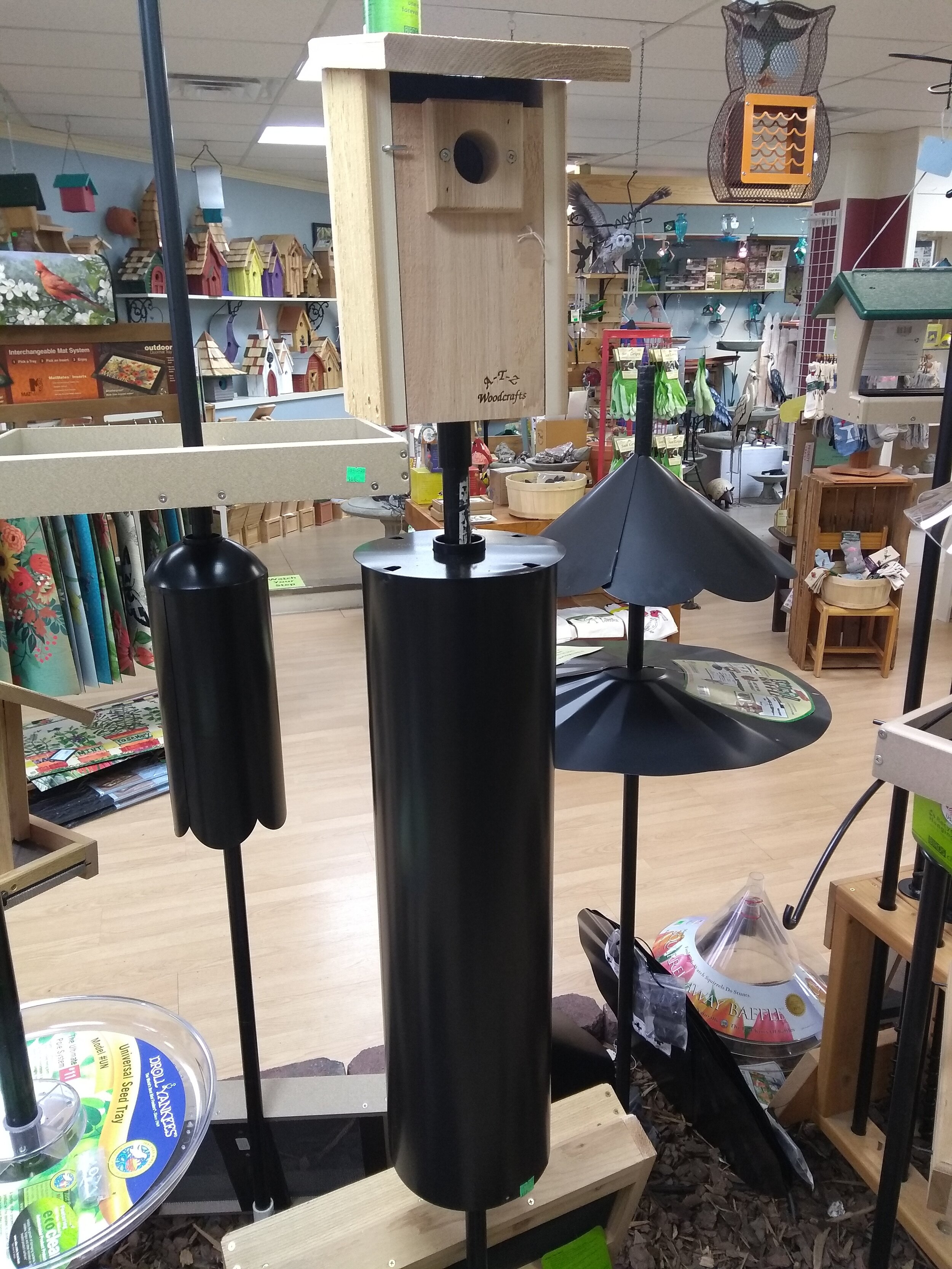
Bluebird box with raccoon baffle.

Bluebird box with raccoon baffle.

Ø How many boxes can be offered in a typical yard situation? As a general rule we would suggest boxes be placed 90 to 100 feet apart, or out of sight of one another. There is no harm in offering lots of nest boxes (birdhouses) in your yard but do not expect them to all get used at the same time especially if they are close in proximity to one another. For instance, nest boxes within 25 feet of one another are not likely to be occupied simultaneously. Birds are too territorial to accept this situation under normal circumstances unless they are colony nesters like Purple Martins and Cliff Swallows. But feel free to decorate your yard with lots of birdhouses if that’s your thing. Offering multiple nest-boxes is great and it does lessen the competition for a single box but do consider the nature of the species you are trying to attract and what kind of setting would be most appealing. I offer many boxes in varied situations in my yard and enjoy observing which ones get used from year to year. Sometimes I’m surprised by the choices made by birds.

Ø We are often asked “when is a good time to put up a bluebird box”? Every day is good. However, it is a great time to do so now and in the next few weeks because the breeding season is fast approaching. The sooner they know the box is there the more likely they will consider using it this season.

And PLEASE, PLEASE, PLEASE remember do not let your desire to attract Bluebirds cause you to clean out other songbird’s nests like Chickadees, Wrens, Tufted Titmice, or White-breasted Nuthatch. In no way does cleaning out these birds nests ensure you will get Bluebirds. Chickadees typically nest earlier than Bluebirds and only once. So PLEASE let the Chickadees have the box if they have begun to nest.

Bluebirds will nest up to 3 times per season and have plenty of time. Even if you do not get Bluebirds during the first nesting there is still time for two more. Besides, if a Bluebird wanted the nest-box it would easily out-compete a Chickadee. Enjoy the fact that you’ve attracted a native songbird to your nest-box and watch the process. It’s a lot of fun.

Bird Bio: Western Tanager

Just when I started to write off this winter as an uninteresting bird feeding season due to warm and wet conditions, our own Eli Haislip witnessed and photographed a Western Tanager at a feeding station. There have only been a handful of reported sightings in TN going all the way back to 1960 and this is the first ever reported in Davidson County! The bird appeared at a feeding station probably interested by the other bird activity. Like Bluebirds, Western Tanagers are primarily insect and fruit eaters but during winter may take advantage of “alternative” food sources like seeds out of the shell, suet, mealworms, or dried fruit.

Western Tanager range map

Western Tanager range map

This Western Tanager is truly out of its normal range which is well west of the Mississippi during the breeding season. See range map. During the non-breeding season these birds normally migrate to Central and South America, like our Ruby-throated Hummingbirds. In the past ten or twenty years, however, it has become commonplace to see some western hummingbirds, like Rufous, Anna’s, Caliope, and Black-chinned migrate to this part of the country for the winter rather than to Central and South America. Why? There’s no absolute answer but it is interesting and gives one cause to pay closer attention. This is why bird researchers and banders encourage people to leave a hummingbird feeder up during winter months.

Adult male Western Tanagers are strikingly beautiful in breeding plumage sporting a red face and throat with yellow underparts and nape, which contrasts sharply with the black back, wings, and tail. As is the case with many bird species females are much less colorful. Female W. Tanagers have a yellow head and underparts while the back is olive-gray and wings are gray with white wing bars.

Keep an eye on your feeding stations. Winter is always a time when something “different” may appear. If anything looks a little different to you stop and take a closer look with binoculars. Let us know what you see.

Next week get ready for the Great Backyard Bird Count.


Bluebirds in Winter

Recently many of you have seen Bluebirds in your yard and wondered why. The Eastern Bluebird is a year round resident in TN so it should come as no surprise that on any given day you may see them appear in your yard to take advantage of a birdbath, or check out a nestbox, or even visit a suet feeder, as I see them do with some regularity. Their main food sources consist of insects and fruit, but on cold day’s insects may be hard to find and since many other birds also take advantage of tree and shrub fruit, it too may be difficult to find. So, alternative food sources such as suet may have appeal. Other foods you can offer Bluebirds include raisins, blueberries, dried and live mealworms, which we stock year-round. In some cases, usually in very wintery conditions, Bluebirds can be seen eating sunflower and peanuts if already out of the shell. They do not possess the seed cracking ability of our usual seed eating feeder birds.

It is quite common to see Bluebirds visit nest boxes during the winter. You may even see them carry some nest material into the box. This is not actual nesting behavior but more than likely a male showing off a good place to raise young to a female. It never hurts to get a head start. We are of the opinion there is no time like today to put up a new Bluebird box. The sooner they see it the better.

And Bluebirds have been known to roost in a nest box, again, usually during more extreme winter conditions.

Keep your eyes upon the backyard and let us know what you’re seeing. Keep the water fresh and feeders clean. This is a good time of the year for an interesting bird to appear at water or food.

The Yellow-bellied Sapsucker and Wet Weather Bird feeding Help

This winter if you see a woodpecker that doesn’t quite look like any of the usual woodpeckers you regularly see you probably have a Yellow-bellied Sapsucker. A little smaller than a Red-bellied Woodpecker at about 8 ½” in length , the Sapsucker gets its name from its telltale habit of creating evenly spaced holes around a tree trunk or large shrub to release sap to feed on. The drilling does not kill the tree because the tree is not being girdled. Note: I have a Viburnum at my home that is 25 years old and riddled with Sapsucker holes. It leafs out and blooms every year.

The Sapsucker is a fairly common winter visitor across the state of TN found in residential yards as well as in woodlands. It is a handsome bird known for its red forecrown on a black and white head; the chin and throat are red on male, white on the female. The back is blackish with a varying pattern, with a white rump and large white wing patch. The underparts of the bird are yellowish, paler on a female. They clearly stand out among our usual woodpeckers.

Suet is a good choice to attract Sapsuckers, although I do see them going to fine sunflower hearts presented in a finch feeder. I use mainly peanut butter suet and see sapsuckers feed there all winter. Video Other things to try are fruit and nectar. Nectar can be offered in a standard hummingbird feeder and sapsuckers may find this a suitable supplement to tree sap. After all, many of you see Downy woodpeckers feeding on hummingbird feeders all summer long. Sapsuckers have the same long tongue that can wick nectar out of the feeder. Sapsuckers generally leave this area by mid-April and head back north to their breeding areas. Look for this bird and let us know if you see one.

Notable sightings in TN this past week include Pacific Loon at Percy Priest Lake and a

Black-chinned Hummingbird in McMinn County, TN. I spent a day at Centerhill Lake recently and saw at least a dozen Common Loons.

Winter tends to be our wet weather time of the year. Soaking rains can present a number of problems at feeders, especially feeders that contain shelled offerings like sunflower hearts, Premium Blend, shelled peanuts, and suet. Everyone who’s fed birds for any length of time has encountered the awful experience of cleaning out a feeder full of wet, ruined seed. It’s really messy and it stinks, and your investment in the more expensive seeds is lost. Try protecting your investment with one of the many weather guards, or hanging squirrel baffles, available for a variety of feeders. Hanging Squirrel Baffles are just larger versions of weather guards thus offering optimum weather protection.

Late Summer and Early Fall Hummingbirds

Wow! My hummingbird feeders have been working overtime for a week and a half now. Yesterday evening my wife and I estimated approximately 50 hummingbirds swarming the 5 visible feeders on our back porch. This morning we saw the same thing. It was hovering room only. There is no doubt that we are experiencing the peak of hummingbird activity which means we will soon begin to see numbers of hummingbirds dwindling with each day that passes. As the days grow shorter hummingbirds will instinctively feel the urge to go. For now, though, we are thoroughly enjoying the action. And I am paying very close attention in case a different kind of hummingbird appears. Recently, a friend of mine in the western most part of Bellevue had a confirmed Rufous hummingbird at her feeders.

Rufous Hummingbird

The Rufous is a summer resident of the west coast, mainly from central California all the way up into northwest Canada. Like the Ruby-throated hummingbird they migrate back to Central America and Mexico and along the Gulf coast to Florida for the winter. However, each year small numbers of Rufous hummers appear in southern states including TN. Late August and September are the months they tend to appear, or at least be seen. Some Rufous hummers have been known to stay in mid TN most of a winter.

The adult male Rufous is quite distinguishable with its rufous (reddish brown) back, flank, rump and tail. The head and crown are even darker brown to red, a red face, and bright red gorget and white breast. Pic of Male and Female Rufous

Adult females have a green back and crown with hints of rufous on the flanks. A central grouping of red spots may be visible on the white throat. Juvenile males and females will look very much like the adult female with the exception of the red spots. A lone juvenile Rufous would be difficult to notice amongst a group of Ruby-throated hummingbirds.

Rufous hummers are reportedly even more aggressive about guarding a food source than Ruby- throats, if you can imagine that.

The video was taken on my back porch this morning. Most of you do not get to see multiple hummingbirds on a feeder at the same time. In more rural areas it is quite common to see. Continue to keep your feeders clean and nectar fresh. You might be the next one to see a Rufous hummingbird.