
BIRD NEWS BLOG
Wood Thrush Notes
Who’s Knocking?
It started recently and maybe you’ve noticed, maybe not. There’s a very audible “knocking” sound that seems to go on and on sometimes for several minutes at a time. The sound may be very close by, it may be deep in the woods, sometimes from multiple locations. It sounds like two pieces of wood rhythmically making contact. I’m embarrassed to say it took me awhile to figure this little mystery out. My initial thought was it’s a bird. The Yellow-billed Cuckoo, a bird that I hear regularly throughout the summer, makes a clucking sound yet it is distinctly different than the knocking I was hearing. And as I was hearing this knocking well into October and November it did not make sense that it would be a Yellow-billed Cuckoo as they migrate back to S. America in the fall. One day as I was working in the yard the knocking began right in my backyard. I grabbed my binoculars that I keep close and stalked into position to catch the culprit making the sound. It was a chipmunk.
Most information I could find on this behavior referred to the sound as a warning to other chipmunks that danger is present, like a hawk for example. It may very well be the sound is also being used to stake claims on certain areas. In the fall as chipmunks begin to gather food for the long winter they become highly territorial. The work of gathering and storing food can mean life or death for them. Turf wars begin and it’s every chipmunk for him or herself. Chipmunks do not hibernate but may stay in their dens for long periods of time only coming out briefly when temperatures are conducive to gathering extra supplies. They may even go into torpor, a slowed-down state, to conserve energy.
So if you have heard and wondered about the knocking sound you hear this time of year it’s the eastern chipmunk.
Many of us still have hummingbirds although their numbers are dwindling. Remember, there is not a time that you should take your feeders down. Hummingbirds will continue to move through middle-Tn during the month of October. Keeping at least one feeder available can be of great help to these tiny travelers.
Keep your eyes on your birdbaths as weary warblers look for water sources during migration. You just may be treated to one of the many beautiful species of warblers bathing and drinking in your yard.
Summer Hummer Notes
This week’s blog addresses a few of the questions we get on a daily basis this time of year. Without a doubt the number one question asked is “where are the hummingbirds”, or “is there something wrong with the hummingbirds this year”? The answers are the hummingbirds are here, and no there is nothing wrong. As far as we are concerned this is business as usual when it comes to the timing of hummingbird activity. Rate of feeding activity can vary year to year based on factors like excess rain, or drought. In past years, during very dry weather, we would see hummingbirds visit feeders earlier and more often for lack of natural nectar producing choices. This year there has been ample rainfall producing plenty of natural nectar opportunities. And of course hummers consume insects for the protein in their diet. There’s never a lack of insects in TN summers.
Widespread, powerful spring storms, such as the straight line winds we experienced about 2 months ago, could possibly have destroyed many hummingbirds’ nests in progress causing them to start from the beginning. And we know from experience hummingbirds are typically not extremely interested in our nectar feeders until nesting is concluded. So these two factors could cause a delay in hummingbirds looking to take advantage of feeders in areas hit hard by spring storms.
But mostly the reason hummingbirds are not seen in early summer as much as they are in the latter half of July, August, and September, is because they are here to nest and sugar water is just not critical to their normal daily lives. Any day now, though, as nesting concludes, hummers will begin to look to feeders with more interest. This is when 1 or 2 broods of babies will have left the nest, parenting responsibilities of the adult females is done, and the process of fattening up for a couple of months to prepare for migration back to Central and South America begins.
Other voiced concerns in regard to hummingbird feeders include the presence of Downy woodpeckers and House finches, two species of birds that often take advantage of the sweet water in hummingbird feeders, but not to worry, they will not deter a hummingbird. Feisty and aggressive hummingbirds are not concerned with either of these birds and will harass them until they leave, or move over.
Bees and wasps on the other hand can be a problem, particularly Yellow jackets. Hummers are no match for a feeder covered with this aggressive bee. Strategies to reduce the impact of bees on hummingbird feeders include:
Take the feeder down for a few days, or move the feeder to a different location. Hummingbirds seem to be better at discovering the new location easier than bees.
It is believed bees and wasps are most attracted to the color yellow. Since many hummingbird feeders have yellow plastic "flowers" or other parts, try removing such parts or painting them red - once bees learn where food is, they fly back to the hive to report their findings, so avoiding their attention works best.
It may also help to rub a little vegetable oil or a clove of garlic around the feeding ports.
The Aspects brand Hummzinger, or the Bird’s Choice Hummerfest are the best feeders of choice to deter bees. It’s “dish” design never allows the nectar to touch the feeding ports like bottle type feeders. Hummingbirds can easily reach the bottom of these feeders with their long tongues.
Aspects Hummzinger High View available in 8, 12, 16 ounces.
Birds Choice Hummerfest available in 8 and 12 ounces.
Make no mistake, though, the hummingbird activity at feeders is very close to being very busy. If you have been disappointed in the response to your feeders thus far and given up now is the time to make some new nectar, clean up the feeder, and get it back out. If the sugar solution in your feeder turns cloudy, it's spoiled and needs to be replaced. This can happen in as little as two days in the kind of heat we are experiencing this week.
And a reminder that the proper solution is 1 part sugar to 4 parts water. Do not add color or honey which can be harmful.
Have a nice weekend and we’ll see you soon.
Dealing with Raccoons
You step out in the morning to find your birdfeeder on the ground and squirrels are gathered around it munching away on your deluxe birdseed you just bought, and maybe even on the feeder, too. You cuss the squirrels like any normal person would, and chase the squirrels clapping your hands like a lunatic while your neighbors peer at you from a window with fear and concern. They think being quarantined has finally gotten to you. Admit it, you’ve done this. But hold on. Maybe you’ve cussed the wrong animal.
Finding your feeder on the ground in the morning is likely due to the activities of our TN state mammal, the Raccoon. They routinely work the night shift raiding bird feeders, hummingbird feeders, and trash cans. The squirrels are simply taking advantage of the leftovers. Perhaps Raccoons know if you see squirrels gathered around your feeder on the ground you will conclude they were responsible. Raccoons just may be that smart. Just because you never see a Raccoon doesn’t mean they aren’t coming around. Raccoons are extremely intelligent and resourceful, and can efficiently remove birdfeeders from hooks and hangers in trees, climb a ½” diameter pole with a squirrel baffle in the way, fidget with lids on seed containers until they get them off, and will eat all the cat or dog food you left out for Fluffy or Fido. They are likely the best example of a true omnivore. They are extremely adaptive and use their dexterous front paws and long fingers to find and feast on a wide variety of fare. And they are as at home in the forest as they are in urban areas.
The next few months are typically when we hear the most frequent and numerous complaints about damaged feeders. Why? Just like birds consuming more because of the breeding season Raccoons are also having young, cubs as they are called, and are out every night looking for easy food sources like your feeders.
Females have one to seven cubs in spring to early summer. The young raccoons often spend the first two months or so of their lives high in a tree hole. Later, mother and children move to the ground and the cubs begin to explore their surroundings.
Unfortunately, the list of solutions is limited. The first recommended remedy is to remove the feeder, or feeders, in the evenings leaving nothing for the raccoons to find when they visit at night. Yes, this is inconvenient but it isn’t permanent. Usually two weeks of this strategy is enough to cause the raccoons to change their search pattern. It is extremely effective and inexpensive.
The second choice involves hardware. Our heavy duty shepherds pole, or 1” diameter pole system, with a raccoon baffle will work to keep these fur bearing bandits from getting your birdfeeders. A Raccoon baffle is double the length of a squirrel baffle and larger in diameter, too. Ones that we stock are made to fit certain ½” diameter poles up to a 1 3/4”
Many of you have heard that feeding them will keep them away from your birdfeeders. This typically just encourages more raccoon traffic. They will eat what you intended for them to have and get your feeders too.
As for live traps to relocate the animal I am not an advocate, particularly this time of year when they have cubs. And there are always more Raccoons that will come along.
So, next time you see your feeder on the ground don’t be so quick to blame the squirrels.
Feeding Bluebirds
Everybody would like to attract Bluebirds. The fact is it is not difficult to attract Bluebirds and the single best way to do that is with a couple of nest boxes placed in good locations as we pointed out in previous blogs. (Click here for tips on bluebird box placement.) We want to help you attract Bluebirds and enjoy the entire experience from courtship to nest building, egg laying to chick development, and finally fledging.
Besides the nest boxes planting native berry producing trees and shrubs, like Dogwood and Beautyberry, for example, having a consistent source of water, and offering an appealing food source like live mealworms are things that will help. Eastern Bluebirds feed primarily on insects and berries, so feeding them is very different than the way we feed other birds. Many of you have seen Bluebirds this winter going to suet and seed out of the shell, but this behavior usually subsides when warm weather and insect activity increases. At The Wood Thrush Shop we have a great deal of experience feeding Bluebirds and would like to pass on our tips and tricks to help you have success and enjoy the activity as much as we do. We really don’t think presenting mealworms before Bluebirds are regularly present is a good strategy. In other words just presenting mealworms randomly is not likely to attract them. All you are doing is presenting this very desirable food source to a lot of other birds.
The best time to begin offering live mealworms is when Bluebirds begin consistently checking out a nest-box. Their need for nest boxes takes precedence during the breeding season and will bring them to your yard more predictably and reliably, and potentially for several months. Feeding them then becomes a lot easier after they have found a nest-box.
Once you see Bluebirds showing interest in a nest box be prepared to offer mealworms. The type of feeder to use is really not very important. My choice of feeder is a small clay dish which is placed on a large rock which is easily seen from the top of the nest-box, just a few feet away. Platform type feeders tend to work very well, too. Won’t other birds find the worms? If you follow our guidelines other birds will not be wise to the offering.
Look for an opportunity to walk out to the feeder and offer a small amount of worms, maybe a dozen. THIS IS IMPORTANT! The key is to make sure the Bluebirds are there to see you make the offering.
After placing the worms in the feeder walk away and watch. In most cases you will see immediate interest. They may fly right down to the dish and gobble them up. If their reaction is to fly away do not leave the worms there. Try again another time. If they immediately consume the worms offer another helping to reinforce the process. I repeat this little scene every time the opportunity arises over the course of the next few days or weeks. Usually 4 or 5 times is enough for the Bluebirds to catch on to what you are doing. It is VERY IMPORTANT that if during that first offering they fly away do not leave the mealworms there. The longer the worms are there the greater the likelihood that other birds, like Robins, Mockingbirds, Jays, or Starlings see them. If these birds catch on to this offering feeding the Bluebirds will then become almost impossible, not to mention possibly creating enough conflict the Bluebirds may look elsewhere to nest.
Both Mockingbirds and Robins share the same food preferences as Bluebirds and being bigger birds will vigorously defend a food source like mealworms. If you slip up and allow larger more aggressive birds to compete for the worms we suggest a reset. Stop putting out worms for a week or two and begin the process again. Better to be patient than to create an adverse situation.
So, keep the offerings minimal until the Bluebirds really catch on. Then you can increase the amounts of mealworms being offered as they raise their young. Soon they will be anticipating the offering, or even seeking you out in your yard as I’ve experienced in the past.
Offering mealworms when Bluebirds are not present is a sure way to feed a lot of other birds. Wait until you see them before offering.
If birds that you do not want are getting the mealworms suspend offering the mealworms for a few days or more and start over using the suggestions we’ve outlined.
Bluebirds may partake of other foods like dried mealworms, suet, Bluebird nuggets (a type of suet), raisins, blueberries, chopped apple and grape. Experiment and let us know your results.
Location is important. Don’t try to feed them near birdfeeders or a place that gets a lot of bird traffic. Feeding them close to their chosen nest box is easiest but do make sure you don’t let other birds in on the mealworms treat. Some birds may become territorial over the food source and create conflict at the Bluebird box.
Some people employ the method of making a sound, like whistling, while they offer the worms. Bluebirds will key in on the sound and associate that with the treat about to be given them. Its simple conditioning. I’m convinced that the Bluebirds we fed behind the store one year became familiar with the sound and sight of my truck arriving in the morning. As soon as I would get out of the truck they would be landing on nearby perches waiting for me to enter the store and bring out worms.
Remember, Bluebirds will not become dependent on the mealworms but will simply take advantage while they are offered. You can suspend feeding Bluebirds any time and not worry that they will be adversely affected.
Bluebird Feeders and Mealworms Special!

Domed feeders can be adjusted to help discourage larger birds.
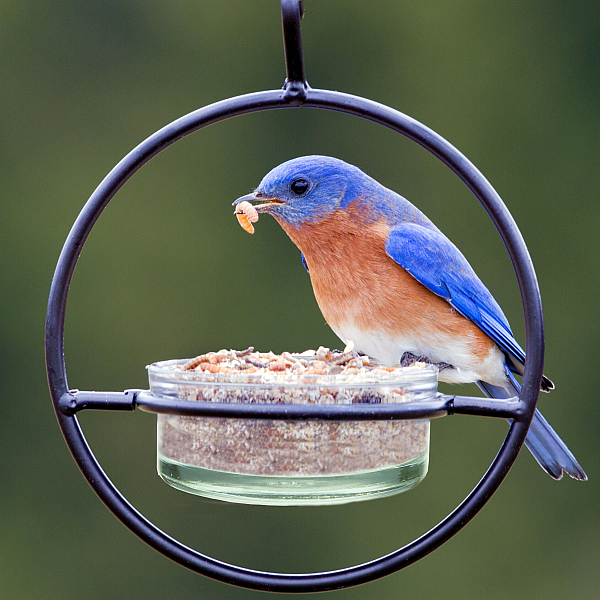
Bluebird feeders can be any small dish or tray. however I would not put this many mealworms out at one time.
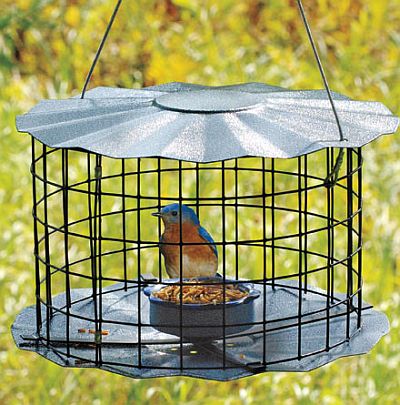
Barrier type feeders will limit the size of bird that can feed. These feeders may take longer to train your birds to use.
Get Ready for Bluebirds
In the coming weeks we will be sharing information about Bluebirds. We would like to address specific questions and concerns you may have that can then be shared with everyone. If you have questions regarding Bluebirds please email us at thewoodthrushshop@gmail.com.
Have you noticed? Birds are singing and going through some of the motions of courtship. The breeding season is fast approaching. Its evident Eastern Bluebirds are already searching and competing for mates and potential nest-sites. Several times in past weeks I’ve seen multiple Bluebirds land on and look in the nest boxes around my yard. (See video) In the video you will see classic courtship behaviors like wing fluttering. Many of you have reported likewise.
Although most Bluebirds won’t begin their first nesting until late March to mid April, their search for nest sites will typically intensify in the last weeks of February and into March. A few eager Bluebirds may get on nest as early as mid-March.
You may think you don’t have the right situation for Bluebirds because you’ve heard they have very specific needs for a nest-box location. Not really true. Most things you hear about what Bluebirds NEED are very much over stated. Bluebirds adapt very nicely to all kinds of yard situations. If Bluebirds needed the “perfect setup” as described by the many articles you may read about them they would be extinct by now. These perfect nest-sites generally never existed in nature.
In fact it’s interesting to consider where Bluebirds nested before people started putting out nest-boxes. Bluebirds are considered a secondary cavity nester which means they will not excavate a nest, like a woodpecker, but use one that has been created already. Once upon a time secondary cavities were in great supply but through habitat loss and competition Bluebirds were “forced” to adapt to birdhouses, or what we refer to as nest-boxes. Using nest-boxes is an example of Bluebirds adaptability. Offer a couple of nest-boxes in good locations and see what happens. If you already have nest boxes now is a good time to make sure they are cleaned out and free of old debris left over from last year’s nesting’s.
Here are a Few Tips on Choosing a Location:
Ø An open lawn area may be preferable but not absolutely necessary. Choose the most open location available in your yard even if it means there will be a some human traffic.
Ø Bluebirds are typically more sensitive to a lot of bird traffic, so it’s not recommended nest boxes be placed near bird feeders. What’s a comfortable distance? It’s impossible to be exact but we would suggest 50 to 100 feet away, or out of sight of feeding stations.
Ø You may have heard that nest boxes need to face east. While this may be helpful to keep wet weather from being a detrimental factor this is not something Bluebirds require.
Ø A Bluebird box does not need to be on a pole. The advantage of a pole is it allows you to position the box in the location you determine to be the best and apply a predator baffle if necessary. Bluebird boxes can be mounted to trees, fences, and utility poles. A height of about 5’ is sufficient. Our pole system for Bluebird boxes will put the box at 5’ after installation. The two primary predators of nesting Bluebirds are raccoons and rat snakes. Both can easily climb trees and poles so if you experience regular visits by raccoons you should consider placing your Bluebird box on a pole with a raccoon baffle.
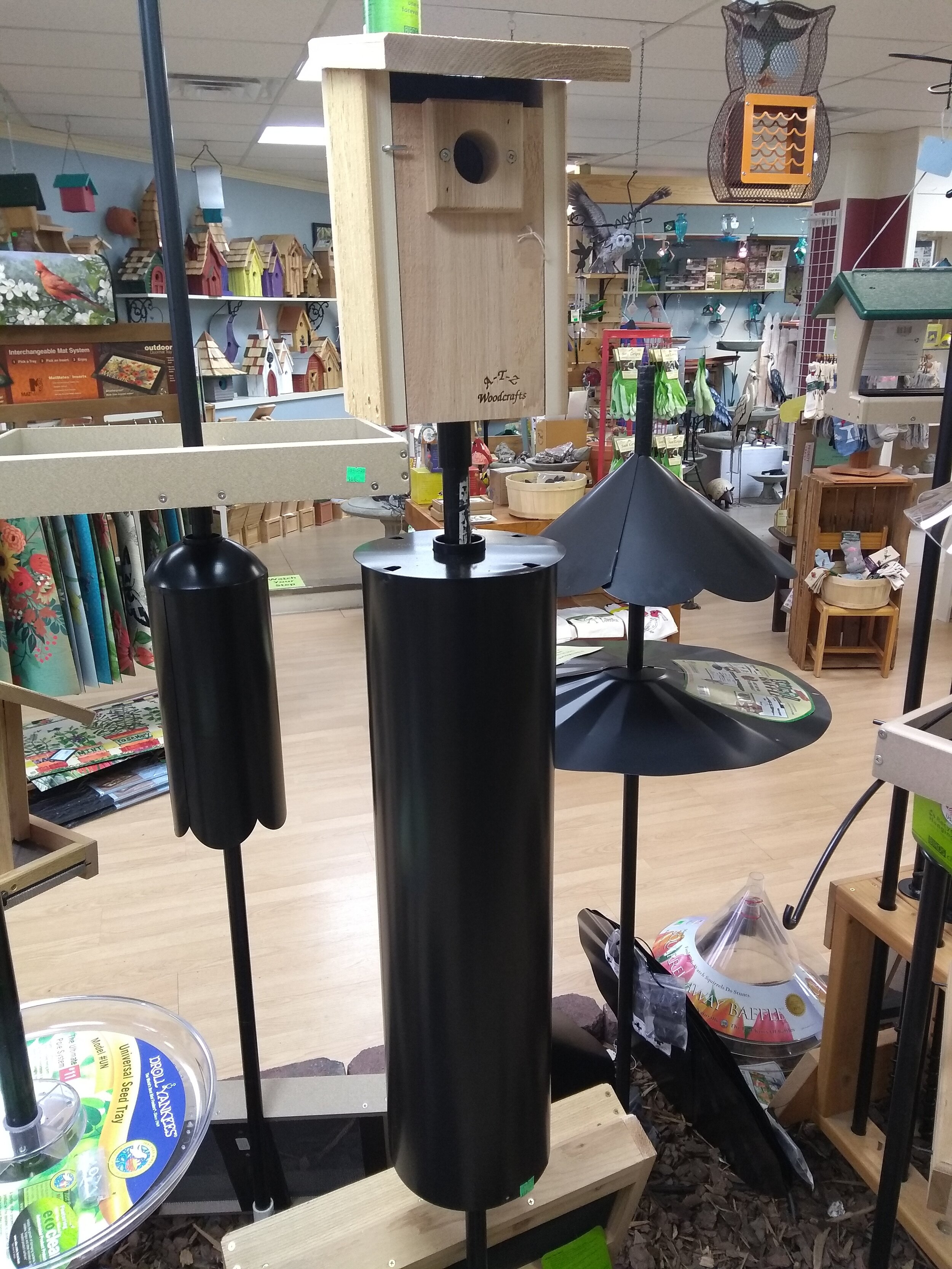
Bluebird box with raccoon baffle.
Ø How many boxes can be offered in a typical yard situation? As a general rule we would suggest boxes be placed 90 to 100 feet apart, or out of sight of one another. There is no harm in offering lots of nest boxes (birdhouses) in your yard but do not expect them to all get used at the same time especially if they are close in proximity to one another. For instance, nest boxes within 25 feet of one another are not likely to be occupied simultaneously. Birds are too territorial to accept this situation under normal circumstances unless they are colony nesters like Purple Martins and Cliff Swallows. But feel free to decorate your yard with lots of birdhouses if that’s your thing. Offering multiple nest-boxes is great and it does lessen the competition for a single box but do consider the nature of the species you are trying to attract and what kind of setting would be most appealing. I offer many boxes in varied situations in my yard and enjoy observing which ones get used from year to year. Sometimes I’m surprised by the choices made by birds.
Ø We are often asked “when is a good time to put up a bluebird box”? Every day is good. However, it is a great time to do so now and in the next few weeks because the breeding season is fast approaching. The sooner they know the box is there the more likely they will consider using it this season.
And PLEASE, PLEASE, PLEASE remember do not let your desire to attract Bluebirds cause you to clean out other songbird’s nests like Chickadees, Wrens, Tufted Titmice, or White-breasted Nuthatch. In no way does cleaning out these birds nests ensure you will get Bluebirds. Chickadees typically nest earlier than Bluebirds and only once. So PLEASE let the Chickadees have the box if they have begun to nest.
Bluebirds will nest up to 3 times per season and have plenty of time. Even if you do not get Bluebirds during the first nesting there is still time for two more. Besides, if a Bluebird wanted the nest-box it would easily out-compete a Chickadee. Enjoy the fact that you’ve attracted a native songbird to your nest-box and watch the process. It’s a lot of fun.