BIRD NEWS BLOG
Wood Thrush Notes: Native plants & Hummingbirds
Consider Native Plants
Many of you, including myself, experienced loss, or at least significant damage, to plants with the rapid temperature drop and freezing weather this winter. Most leafy evergreens really took a hit as wind and subzero temperatures caused leaves to turn brown and drop off. This does not mean the plants are dead, and one will have to wait to see if new growth emerges. But if you are planning on replacing some plants, I suggest choosing native plants.
Habitat loss is the number one reason for species decline as development continues to reduce land once occupied and utilized by insects, birds, and animals. Vast amounts of natural habitat are now becoming islands of habitat. Scientific studies confirm wildlife thrives in greater numbers where gardens are planted with native plants that provide seeds, nuts, fruit and produce valuable blossoms for nectar. Spring is nearly here and gardening will be on your mind. Give some thought to replacing those cultivated varieties of plants with natives and the rewards will be great. Aside from attracting birds that do not visit feeders native plants require less watering, attract pollinators from bees to butterflies, do not require pesticides, survive tough TN growing conditions, and they are beautiful. A great local source and recognized as one of the leading native plant nurseries in the U.S. is GroWild in Fairview, TN. www.growildinc.com
The Perennial Plant Society of Middle Tennessee is another good resource for plants and information. They will be having their annual plant sale on April 8th from 9 am to noon at the Nashville fairgrounds. Visit their website for more information. www.ppsmtn.org
Another organization you may want to be familiar with is Habitat Connection. Habitat Connection is a non-profit organization made up of a small group of people sharing a passionate interest in improving habitat on a small scale, namely our yards. Their goal is to improve the health of our ecosystem in yards and to create connectivity for birds, wildlife, and us. They can help you implement a plan specifically for your yard. Check out their website to learn more, www.thehabitatconnection.org
When are the hummingbirds coming?
It’s a question we hear a lot in the store beginning in February. We are just 2 ½ weeks away from some of the first sightings of Ruby-throated hummingbirds. Ruby-throated hummingbirds (RTH) are in fact moving this way as they do every year at this time. Male RTH’s begin arriving along the Gulf Coast in February preceding females by as much as a week to ten days. There are no exact arrival times but year to year observations suggest they are quite punctual. For 30 years I’ve noted the first siting of a hummingbird at my home. It’s never been earlier than April 4 and never later than April 11. And it has always been an adult male. It's often thought if it's warmer here they will arrive sooner. Perhaps warmer weather will aid them in their migration but it doesn’t mean they will get here that much earlier. After all they do not know it’s warmer here. Migration is triggered by the lengthening of daylight hours, and instinctively they have made this journey from Central and South America for thousands of years. The very earliest hummingbirds may be seen in the last week of March with the bulk of them arriving or passing through from mid-April to mid-May. Many of these birds will continue to their breeding areas as far north as Canada and all areas in between while some settle here for the summer.
The other question we answer regarding hummingbirds is “when should I put a feeder out?” You may put one out as early as the last week of March but do not expect late summer-like activity. Feeders are of assistance but certainly not like they are prior to fall migration. This year may be different in that plants that provide blossoms for nectar may be in short supply from winter damage. We shall see.
Wood Thrush Notes: All About Goldfinch
Why You May Not Have Success Attracting Goldfinches
Next to Bluebirds and Hummingbirds the American Goldfinch is perhaps the most discussed bird at The Wood Thrush Shop. Goldfinches (GF’s) are a year round species here in TN. Males, in their spring-summer breeding plumage, are bright yellow with a black forehead, black wings with white wingbars, and white patches above and below the tail. Adult females are duller yellow beneath, olive above. In winter both males and females are a drab olive, with hints of yellow, and the ever present black wings with pale wingbars.

Non breeding male Goldfinch.

Breeding male and female Goldfinch.
Customers ask, “Where have the GF’s gone” or “why can I not attract GF’s” and “why are they not eating my nyjer-thistle”?
Understanding the Goldfinches habits is important. GF’s are exclusively seed eaters and they search for food as a flock. This fact is most important. It explains their preference for fields and meadows where there are lots of native seed producing plants, and why feeding stations with multiple seed feeders and choices of seed options tend to be more appealing and productive than a feeding station with one seed feeder and one finch feeder. Their desire to feed as a flock is the most important factor.
Because of their unique food requirements Goldfinches are on the move much of the time. During the non-breeding seasons, winter, spring and fall, there are great movements by these birds which may explain their inconsistent presence at feeders. Many of us tend to see more at the feeders in the winter when northern populations have come here to winter.
Goldfinches feed on a variety of seeds including sunflower, safflower, nyjer and millet. I believe sunflower is their preferred seed at feeders, whether in or out of the shell. I use the fine sunflower hearts in my finch feeders and always attract Goldfinches.
Nyjer for finch feeders is not a seed native to this country and is grown primarily in Africa, particularly Ethiopia and Kenya, as well as in India, Nepal, and Myanmar. This explains why Nyjer is a little pricier and perhaps why it may not be as appealing to Goldfinches as we once thought.
GF’s will go to any type of seed feeder including platforms. They will feed on the ground, too. During wintry weather I have spread sunflower and millet on my driveway and been treated to a flock of 50 or more Goldfinches.
Here are a few things to keep in mind to have more success with GF’s
Keep your finch feeders topped off. Waiting for GF’s to finish what’s in the feeder will backfire because if what’s remaining in the feeder accommodates only two birds they will move on. Often customers will think there’s something wrong with the remaining seed but probably not. Shake the feeder to see if the seed is dry and loose. If it is just top it off. If it has gotten wet and is now clumped remove it and refill.
• Employing other seed feeders is helpful in three ways. It provides more feeding opportunities and a variety of seed choices. As GF’s search for available seed sources they will notice other seed eating feeder birds and investigate what they are feeding on.
• If you have multiple finch feeders keep them fairly close to one another promoting the “flock feeding” preference.
• Keep your feeders clean and the seed in good condition. I can assure you GF’s have plenty of food choices in nature so your feeders need to be at their best to compete.
Understanding the habits of GF’s and following some of the suggested tips should help you attract this beautiful bird with more consistency.
Wood Thrush Notes: First Migrants Arrive in TN.
Sale Continues and GBBC
Our February sale continues through this Saturday the 18th on all bird feeding related products. Seed and feed, and all bird feeders and accessories are marked down. Get ready for the Great Backyard Bird Count which takes place Feb. 17-21. Take part in this fun activity where your backyard bird data is used by the Cornell Lab of Ornithology. Visit www.birdcount.org for more information.
First Neotropical Migrants Arrive in TN
We naturally think of migration happening in “spring” and “fall”, however, spring migration has already begun and just last Saturday some of the earliest songbirds arriving from Central and South America were spotted in a couple of locations in TN by avid birdwatchers. One location, the Duck River Unit of TN National Wildlife Refuge in Waverly, is a very popular and productive birdwatching location.
Neotropical means relating to or denoting a zoogeographical region comprising Central and South America, including the tropical southern part of Mexico and the Caribbean.
Tree swallows were spotted in both Chattanooga and Waverly. Tree swallows are a beautiful bird that we see with regularity using Bluebird boxes statewide. We have had customers report having Tree swallows in Bluebird boxes for many years now. Tree swallows are primarily insect consumers, but unlike other swallows, can eat plant foods which help them survive potential wintery weather of early spring. Tree swallows are often seen in open field areas away from trees but get their name from commonly nesting in tree cavities.

The Swallow family in general is among the earliest migrating birds to return to N. Am. every spring. This family consists of Purple Martins, Tree, Cliff, Rough-winged, and Barn swallows.
Spring migration for Ruby-throated hummingbirds, as usual, is closer to April. It is not uncommon for a few hummingbirds to be seen and reported the last week of March, but the vast majority of Ruby-throated hummingbirds will arrive in, or pass through, TN between the first of April and mid-May.
Wood Thrush Notes: Our Big Sale & Mockingbirds
Sale Begins Tomorrow
A reminder that tomorrow, Sat. 11th we are beginning a week long sale on all things bird feeding related. Prices on ALL birdfeeders, iron poles, hooks, and deck mount arms, baffles, weather guards, and seed and suet will be reduced. Get ready for the Great Backyard Bird Count which begins Feb. 17th. Visit the Cornell Lab of Ornithology website allaboutbirdes.org for more information.
Mockingbirds being Mockingbirds
Every early February we encounter several concerned customers that claim they do not have any birds coming to their feeders. “They’ve disappeared in the last week or so”. We usually ask some standard questions that may give us some clues as to the possible reason. Then it occurs to us that the month of February is typically when our state bird, the Northern Mockingbird, begins expressing its territorial nature with much more exuberance. Mockingbirds begin establishing boundaries relative to an intended nest sight much earlier than most songbirds and if any birdfeeders are in that territory they will swoop in and chase off all intruders. They have no interest in the seed in the feeder but will defend with vigor the area the feeder is in. Mockingbirds, nor any birds, possess the trait of being mean. They just have varying degrees of territorial defense and posturing. The Mockingbirds’ is high and with each day spring gets closer its amplified. The only solution to continue feeding your birds is to spread your feeders out enough that the Mockingbird cannot effectively patrol them. In time this heightened behavior will pass and there will be relative peace in your yard again. Once nesting responsibilities commence they generally do not have time for constant patrolling. You still may see an occasional act of aggression, though. Be patient and understand it’s just a Mockingbird doing what it knows to do.

Wood Thrush Notes
Great Blue Heron Rookery
While canoeing on the Harpeth River last weekend I pulled onto a gravel bar to stretch my legs. As I looked around, I noticed in the distance a large tree with what looked like large clumps of mistletoe growing in the top 3rd of the tree. A moment later a very large bird approached and landed near one of the large clumps which I soon realized were Great Blue Heron nests. Through closer observation with binoculars I could see there were already two more GB Herons positioned alongside other nests. I had located a rookery which is an area where Great Blue Herons nest in groups, or colonies.
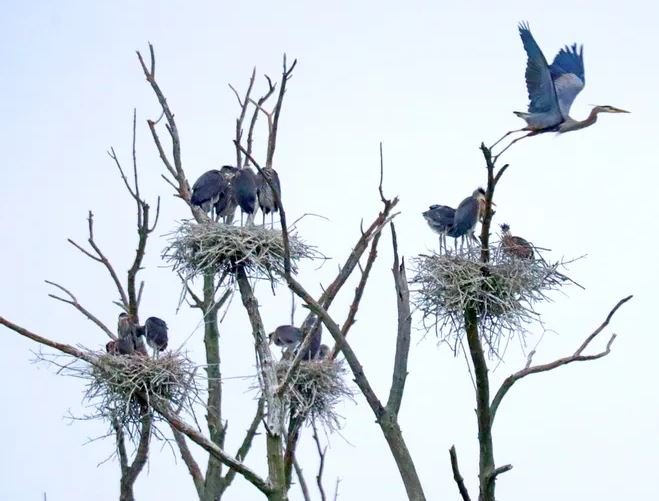
Great Blue Herons nest mainly in trees, but will also nest on the ground, on bushes, in mangroves, and on structures such as duck blinds, channel markers, or artificial nest platforms. As early as late January males arrive at the colony and begin to settle on nest sites; from there, they court passing females. Colonies can consist of 500 or more individual nests, with multiple nests per tree built 100 or more feet off the ground.
Male Great Blue Herons collect much of the nest material, gathering sticks from the ground and nearby trees, presenting them to the female. She weaves a platform and a saucer-shaped nest, lining it with softer materials like pine needles, moss, and dry grasses. Nest building can take from 3 days up to 2 weeks; the finished nest can range from a simple platform measuring 20 inches across to more elaborate structures used over multiple years, reaching 4 feet across and nearly 3.5 feet deep.
Peak egg laying is around mid-March her in TN. A typical clutch size is 2-6 bluish eggs, and incubation takes up to 29 days. The fledgling period is a minimum of about 49 days and can be as much as 81. Individuals usually do not nest until at least 2 years old.
Great Blue Heron rookeries are not difficult to find, especially this time of year with no leaves to obstruct views of nests. They are common year-round residents and can be found along, or near any body of water.
Spring Birding Class
Richard Connors will be offering his bird identification class “Birding by Ear, Bird Study by Sight and Sound” at Radnor Lake again this spring.
The class will emphasize birding by ear, and is designed for beginners and intermediates, and will be a good opportunity for anyone wishing to brush up and study our local birds. Classroom sessions will be combined with guided bird walks taking advantage of the fact that Radnor Lake is the premier place to see, hear, and study birds in the Nashville area. Our local birds will be covered, and of special interest will be the wood warblers, the elusive and colorful spring migrants that Radnor is so famous for. Through this class you will increase your proficiency in bird identification, learn how to enhance your yard to attract birds, learn what bird resources are available, and learn where to go in our area to look for birds.
The 5-week class will meet Tuesdays April 4, 11, 18, 25, and May 2. The first class meets on April 4th, 10AM – 12:00 PM in the visitor center meeting room, Radnor Lake State Natural Area, 1160 Otter Creek Rd., Nashville.
Morning bird walks start April 14 at 7:30 AM, followed by classroom sessions starting at 10 AM. There is a $75 fee for the class, with a portion of the fee going to Friends of Radnor Lake.
Contact Richard to register for the class: Rconnorsphoto@aol.com, call or text 615 330-7142. For more info visit Richards info page here. https://pbase.com/rconnorsnaturephoto/spring_bird_class_2023