
BIRD NEWS BLOG
Early Summer Hummingbirds
A day doesn’t go by at The Wood Thrush Shop that we are not asked “what’s wrong with the hummingbirds?” “I don’t see any coming to my feeders.” “Are they here”?
All of our summer resident Ruby-throated hummingbirds are here and well into their first or even second nesting of the season by now. Like Bluebirds they all don’t start nesting at the same time. There could be as much as a month difference in the first nesting phase of the earlier arrivals in March and April and the later arrivals in late April to mid-May.
The nesting phase is the reason people generally see far less of hummingbirds now as opposed to mid-July through September when they are seen so readily at feeders. One must remember hummingbirds do not come all the way from Central and South America for sugar water. It’s of little need to them during the first half of their summer residency. They are very satisfied with nectar from flowering plants, and insects for protein. Hummingbird feeders are not in high demand at this time and will serve only for quick visits and a brief drink. When nesting is near conclusion in mid to late July and early August that is when hummers begin visiting feeders with frequency and intensity to fatten up in preparation for the long migration back to Central and South America.
With that in mind keep fresh nectar in the feeder but do not fill to capacity. Small amounts are recommended now to decrease waste and major cleaning of feeders. In warmer weather with temperatures near 90, nectar is only good for 2-3 days at a time. If your feeder is getting full sun you may want to adjust to a shadier situation or be prepared to change the nectar even more frequently.
Remember to only use plain white table sugar to make nectar, no brown or raw natural sugar, no honey, and no color. A 1 part sugar to 4 parts water ratio is the perfect solution. Making it sweeter is no more appealing or beneficial to the birds.
Be patient, hummingbirds will begin visiting feeders when they are ready. We should see an uptick in activity around mid-July.
We will be closed Monday, June 19th.
We will see you on June 20th!
Monitoring Bluebird Boxes
It’s great that so many people are interested in providing nest boxes for Bluebirds, and because of these efforts Bluebird populations are extremely robust. We encounter customers, though, that ask a lot of questions they would have the answer to if they just monitored the nest box a little. We do not mind answering the questions, it’s very much part of the job.
Most of the time when we mention to a customer they should consider monitoring the box their response is “I don’t want to disturb them or scare them away”. If done properly neither of those things will happen. Not only is it interesting and a great nature and biology lesson, you can predict within a day or two when the babies will leave the box. And another reason to monitor is you may actually keep something bad from happening to the babies. I’ve often told customers of the time my son, who I taught to monitor, discovered one of our boxes with four two day old Bluebird babies was infested with ants. In just 48 hours, since the last monitoring, ants had found the newborn babies and were likely going to consume them given enough time.
We carefully removed the babies and placed them in a little box, then removed the entire nest from the box while the female watched from a nearby tree limb. We first cleaned all the ants out of the now empty nestbox and made sure no more would climb the pole. Then we constructed a rather poor replica of the nest using their preferred nest material pine straw. After the nest was back in the box we then removed all the ants from the babies by using a drinking straw to blow the ants off and then placed them back in the box in the clean nest. In all it took us about 20 minutes. The female returned to the box about 10 minutes after we completed the cleaning. Even after removing the nest and handling her babies the female came right back to them because the instinct to raise her young is that powerful. So, monitoring which really just consists of taking a peak for a few seconds will definitely not scare the birds away. Bluebirds tend to be quite tolerant of our presence. Usually they patiently watch as I monitor. Once in a while they will swoop at you clicking their beak in protest. But they will not abandon a nest because of brief looks in the box.
Monitoring Tips
Observing from a distance is important monitoring, too. Seeing bluebirds come and go is an indication they are showing an interest in choosing the box. If you see the pair on and in the box take a moment after they leave to go look inside. You will likely observe nest building at some point. Pine straw and fine dry grasses are the preferred nest material.
Bluebirds tend to lay eggs in the morning hours. The female will lay one per day until done, usually between three and six. Four and five eggs seem to be the most common numbers. She will not begin incubating until all the eggs are laid. So, at this stage I would recommend monitoring in the afternoon so as not to disturb egg laying in the morning. Or, again, if you see the female exit the box take a moment to go look. Take notes. It’s helpful to increasing your knowledge of the process.
When I monitor and see 4 eggs and she is not incubating yet that tells me she has probably one egg to go. I will make note of the date because we know Bluebirds incubate for 12-14 days and then should see babies.
Once I am certain she is incubating I do more monitoring from a distance. If you see the female exit the box and fly off that’s a perfect time to approach and take a look. Be gentle and quiet. I like a box that has a door that opens down as opposed to up. It is so much easier to monitor in a subtle way. I also take pictures to share with people.
Eggs laid before incubation.
Fledglings days after hatching.
Fledglings about a week after hatching.
Now the babies have hatched and I’ve noted the date because we know the babies will take about 14 days to develop and be ready to leave the box. This is known as the fledgling period.
I will monitor daily until by my calculations tell me there are just 2 or 3 days to go until they fledge. At this stage of their development the babies may be fearful enough to want to get out of the box if you open it. I monitor from a distance watching the parents as they make repeated trips with food to satisfy all those appetites.
Hopefully, the calculations are right and you may get a chance to see babies fledge. You will see more animated behavior from the parents as the first and second babies are about to come out for their first flight. Do not be alarmed if all the babies don’t fledge at the same time. It may take several hours for all to fledge.
For more information about Bluebirds and monitoring please visit the National Bluebird Society website. http://www.nabluebirdsociety.org/bluebirdfacts.htm
Wood Thrush Notes: Yellow-throated Vireo
This morning while having coffee on my back porch waiting and watching for the first Rose-breasted Grosbeak to appear at my feeders, I heard a bird call that I quickly identified as a Red-eyed Vireo. Much to my wife’s delight I was wrong. She had opened up the Merlin app to use the Sound ID feature and it identified the bird as a Yellow-throated Vireo. The songs of the two vireos are similar but different enough, too, that I should not have gotten it wrong. Identifying calls and songs is the most challenging part of birding.
Upon locating where the sound was coming from and using my binoculars it was indeed a Yellow-throated Vireo. I blamed my incorrect song ID on the nearly 50 male American Goldfinches that were in full chatter mode descending on all my feeders.
The Yellow-throated Vireo (Y-TV) is a spring migrant arriving from Central and South America. Practically the entire eastern half of the U.S. is in their breeding range. One could easily miss this bird if there is a strong presence of Goldfinches around, although you won’t see them at a feeder. Y-TV’s are insect eaters and will be seen in deciduous forest areas where they tend to nest, hopping slowly from branch to branch looking for prey.

Males will find potential nesting areas and even begin placing some nest material in a few locations waiting on the arrival of a female. She will choose one of the locations and give approval. The male will begin the actual nest building only to hand over the duties to the female after one day. The nest material is comprised of bark strips, dry grasses, rootlets, pine needles, and perhaps hair, held together with spider web or some other insect silk.
Y-TV’s are mostly solitary and shortly after chicks leave the nest the pair will separate.
Just a reminder! If you are interested in placing a special order with us for our Campania cast stone concrete pre-order sale you have through the 18th to place an order. For more information read our Campania pre-order sale blog post from last week. Thank you!
Wood Thrush Notes: Birds to look for.
Coming Soon! Look for these birds at your feeders.
Within the next two weeks you should look for Rose breasted Grosbeaks (RBG) and Indigo Buntings to visit your seed feeders. At feeders RBG’s are the more common of the two migrants and show up in greater numbers, eat more, and maintain a longer presence, usually lasting until mid-May before moving northward to their summer breeding areas. RBG’s winter as far as northern Peru.
Adult male RBG’s are very easily identified with their black and white plumage and big red V on the chest which really stands out against the stark white underside. The head is hooded with black and the wings are black with two white patches, one at the shoulder and one closer to the wing tip. The beak is large enabling this bird to crack open all kinds of seeds and capture insects which are a significant part of their diet during the breeding season.
Female RBG’s are primarily brown and white with a pale yellowish breast and belly, heavily streaked above and below, and have a prominent white eyebrow.
During their migration through TN, they will stop at feeding stations with sunflower, safflower, peanuts, and even suet.
RBG’s have a beautiful song but you may not get to hear them perform as they likely wait until they reach their summer destination.
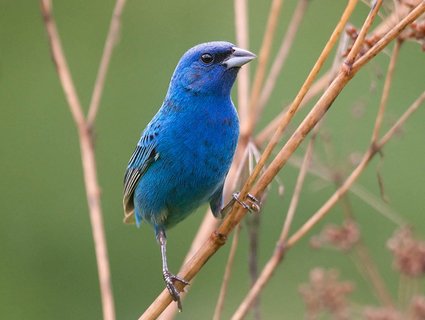
Indigo Buntings may appear at feeders briefly in small numbers. Middle TN is part of their breeding range so it is possible to see a presence throughout the summer. They like a variety of seeds and seem to be most comfortable feeding on the ground. I have seen them on finch feeders.

We are hiring
We are looking for someone to fill a part-time position. Job requirements include customer service and sales, restocking seed which requires lifting up to 50 lbs., and general shop duties, 3 to 5 days a week with a maximum of 30 hrs. per week which includes 2 Saturdays per month. Starting wage is $15 per hour. Reliability, effort, and good work will be rewarded. It is a pleasant atmosphere to work in and customers are very nice. If you are interested, please email John with a resume if you have one, or thoughts as to why you would like to work here. woodthrushshopth@bellsouth.net
Wood Thrush Notes: Native plants & Hummingbirds
Consider Native Plants
Many of you, including myself, experienced loss, or at least significant damage, to plants with the rapid temperature drop and freezing weather this winter. Most leafy evergreens really took a hit as wind and subzero temperatures caused leaves to turn brown and drop off. This does not mean the plants are dead, and one will have to wait to see if new growth emerges. But if you are planning on replacing some plants, I suggest choosing native plants.
Habitat loss is the number one reason for species decline as development continues to reduce land once occupied and utilized by insects, birds, and animals. Vast amounts of natural habitat are now becoming islands of habitat. Scientific studies confirm wildlife thrives in greater numbers where gardens are planted with native plants that provide seeds, nuts, fruit and produce valuable blossoms for nectar. Spring is nearly here and gardening will be on your mind. Give some thought to replacing those cultivated varieties of plants with natives and the rewards will be great. Aside from attracting birds that do not visit feeders native plants require less watering, attract pollinators from bees to butterflies, do not require pesticides, survive tough TN growing conditions, and they are beautiful. A great local source and recognized as one of the leading native plant nurseries in the U.S. is GroWild in Fairview, TN. www.growildinc.com
The Perennial Plant Society of Middle Tennessee is another good resource for plants and information. They will be having their annual plant sale on April 8th from 9 am to noon at the Nashville fairgrounds. Visit their website for more information. www.ppsmtn.org
Another organization you may want to be familiar with is Habitat Connection. Habitat Connection is a non-profit organization made up of a small group of people sharing a passionate interest in improving habitat on a small scale, namely our yards. Their goal is to improve the health of our ecosystem in yards and to create connectivity for birds, wildlife, and us. They can help you implement a plan specifically for your yard. Check out their website to learn more, www.thehabitatconnection.org
When are the hummingbirds coming?
It’s a question we hear a lot in the store beginning in February. We are just 2 ½ weeks away from some of the first sightings of Ruby-throated hummingbirds. Ruby-throated hummingbirds (RTH) are in fact moving this way as they do every year at this time. Male RTH’s begin arriving along the Gulf Coast in February preceding females by as much as a week to ten days. There are no exact arrival times but year to year observations suggest they are quite punctual. For 30 years I’ve noted the first siting of a hummingbird at my home. It’s never been earlier than April 4 and never later than April 11. And it has always been an adult male. It's often thought if it's warmer here they will arrive sooner. Perhaps warmer weather will aid them in their migration but it doesn’t mean they will get here that much earlier. After all they do not know it’s warmer here. Migration is triggered by the lengthening of daylight hours, and instinctively they have made this journey from Central and South America for thousands of years. The very earliest hummingbirds may be seen in the last week of March with the bulk of them arriving or passing through from mid-April to mid-May. Many of these birds will continue to their breeding areas as far north as Canada and all areas in between while some settle here for the summer.
The other question we answer regarding hummingbirds is “when should I put a feeder out?” You may put one out as early as the last week of March but do not expect late summer-like activity. Feeders are of assistance but certainly not like they are prior to fall migration. This year may be different in that plants that provide blossoms for nectar may be in short supply from winter damage. We shall see.