Evening Bats

For 5 years now my wife and I have enjoyed the presence of bats in a “Rocket house” built by a customer–friend that traded it to me for some bags of birdseed. I have to say I got the better end of that deal. Those bags of birdseed are long gone, however, the bat box is a source of fun and interest between March and October as our bat population has grown to over 250 now.

Only this spring we learned they are known as Evening bats, Nycticeius Humeralis. We were able to connect with a person from the Tennessee Nature Conservancy who came to our home to observe the bats exiting the box. He filmed them and used a sound device that records and translates their “calls” to sonograms. Each bat species’ call has a unique and identifiable sonogram. During his visit we counted approximately 150 bats leaving the box.

Then came the night of June 9th and we were watching the bats emerge when we saw something fall from the box and not fly. Upon a closer look I was shocked to discover a baby bat, perhaps just a day or two old clinging to the post the box is mounted on. We suspected but now had proof our colony of bats are females raising babies.

Baby Evening Bat.

The Evening bat is an abundant bat throughout the southeastern US, north to the upper Midwest and Ontario, and along the Atlantic seaboard into Florida.

The evening bat is almost never encountered in caves and is considered a forest bat. It forms nursery colonies in hollow trees, sometimes in buildings and attics, and fortunately for us, in bat houses. Some maternity colonies are quite large, containing several hundred individuals. Evening bats emerge soon after dusk and forage on a large array of small nocturnal insects including flying ants, Japanese beetles, June beetles, and moths. Take note mosquitos were not mentioned. While they may eat mosquitos when encountered, bats are typically feeding at a more elevated level while mosquitos are closer to ground level.

In the fall, evening bats store large amounts of fat for a potentially lengthy migration to southern parts of their range. In a banded bat recovery study, evening bats were found as far as 300 miles south of their banding sites. Still, little research has been done to learn the exact migration movements of this species. The bats have not been found hibernating in local caves and simply disappear from their summer habitat. Once these bats have arrived at their wintering sites, they are thought to remain active throughout the winter.

Breeding occurs in the fall, and delayed fertilization allows for the birth of 1-2 young in late May through June. Young begin to fly after 3 weeks but continue to nurse until 6 to 9 weeks.

On another recent evening as we watched the bats emerge one flew directly toward us somewhat awkwardly and as if it realized it had made a mistake crash landed onto the deck between us.
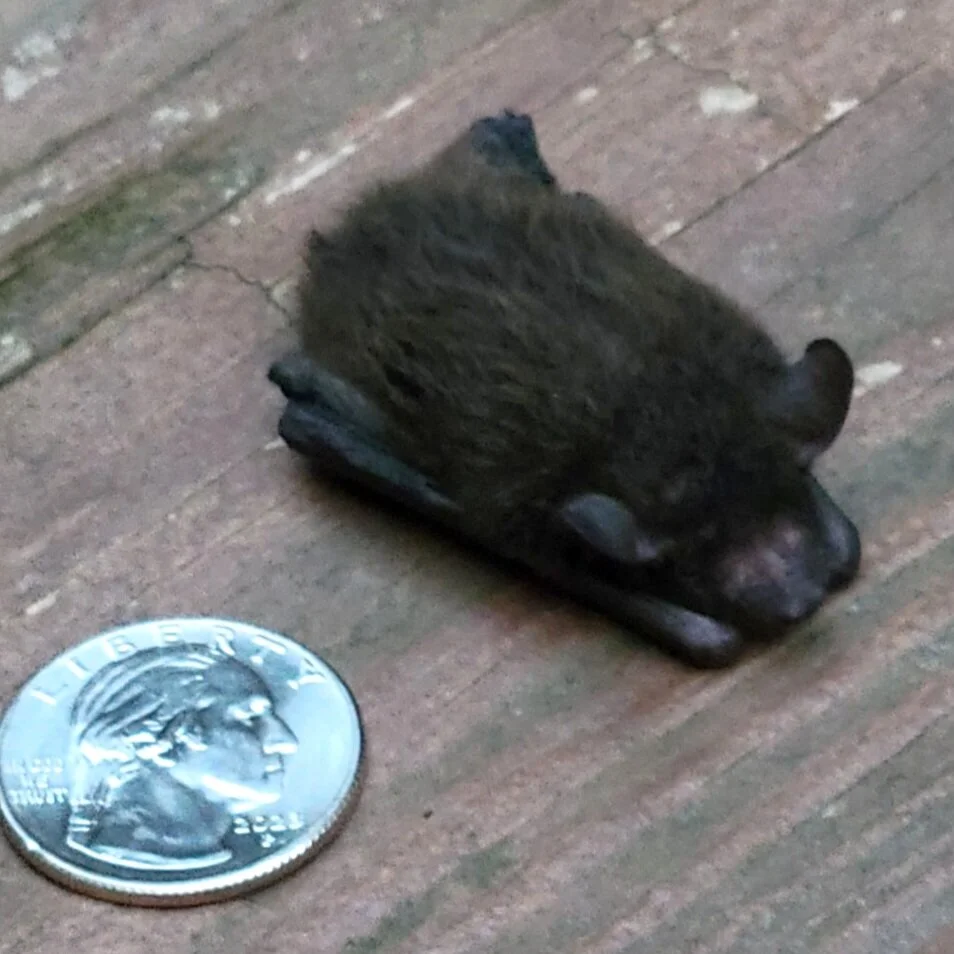
The picture is the young bat aside a quarter I placed next to it for perspective. I assisted the little bat in getting back to the post where it climbed up into the box safely. From our counts earlier in the spring of around 150 to our counts now of over 250 it’s reasonable to conclude we are seeing over 100 offspring. Clearly there is some overcrowding and we are going to add another Rocket house nearby to, hopefully, encourage more. Other bat houses are good, too, and I recommend visiting the websites below to learn more. It’s interesting that the more we learn about these docile, beneficial, creatures the more questions we have. We hope to continue cultivating the success we are experiencing and learn much more in years to come.

Other species of bats seen in TN include Brazilian free-tailed, Eastern pipistrelle, Eastern Red bat, Eastern Small footed, Gray, and Hoary bat.

www.batcon.org www.merlintuttle.org

Wood Thrush Notes

Store Schedule Alert

The Wood Thrush Shop will be closed Wednesday, July 26th.


Late Summer Bird Feeding Notes

Goldfinches are on nest now so if you are seeing more, or less at your feeders, that could be the reason. They of course begin nesting much later than other songbirds probably because they are exclusively seed eating birds. A lot of natural seed forage will be present about the time baby Goldfinches start leaving the nest helping them to sustain life for the first several months. Goldfinches can have 2 broods per year.

There are most definitely peaks and valleys to the bird feeding year and we have always recognized spring and the first half of summer as the busiest segment, even more than winter. Why? It is most certainly because during the spring-summer breeding season nesting birds take full advantage of our feeders. As they expend a lot of energy raising young they are able to feed themselves without the extra effort of having to search for food. But as the breeding season comes to an end and babies are now mostly on their own, feeders are not as important in their daily lives. Insects are the most plentiful food right now and this bounty will be present for the next several months to come. Without young to care for, naturally, our seed feeders will slow down from the torrid pace we’ve seen since April. Gradually, feeders become less important and when October arrives we will experience the slowest bird feeding month of the year. In October every plant and tree has produced nuts, seeds, and fruit. There is more food available at this time than they know what to do with. Well, actually, they do know what to do with it. They will feed mainly on what nature provides and many songbirds will begin caching food away in hiding places. Chickadees have been known to cache food in as many as 200 different locations and remember them. Insects are still available, too, which means our feeders become pretty uninteresting.

Anyone who thinks birds become dependent on feeders doesn’t really understand birds. While they take advantage of feeders during critical times of the year; breeding season, extreme weather, etc., they by no means become dependent and there really is no evidence to support that claim. If birds became dependent why do, for example, Rose-breasted Grosbeaks always leave us in the spring? We see them at our feeders for as much as a month, why do they not stay? Instinctually, they must go. They are, in a way, programmed to go to the breeding grounds they have gone to for thousands of years. Furthermore, because of all the natural food sources available in the fall Rose-breasted Grosbeaks rarely visit our feeders on their return to the tropics. Same thing with hummingbirds. They won’t stay here because we offer them sugar water. They do not become dependent.

Over the next few months as you buy seed you may want to buy smaller quantities knowing feeders will be slower, and avoid bug issues in the process. Storing seed for months in warm conditions can result in a buggy surprise in your seed container. The Indian meal moth is a common problem in all kinds of products, including dog and cat food. Storing smaller quantities of seed in a cool environment is the best way to avoid these troublesome insects. If you happen to notice some insect activity in your seed you can simply put it in the freezer overnight, or use the remainder of the seed immediately. The seed is not a danger to the birds and the little moths and their eggs are just another source of protein.

Bird Bio: Brown Thrasher

Holiday Store Hours

The Wood Thrush Shop will be closed Monday and Tuesday, July 3rd and 4th. We hope you have a fun Independence Day weekend. See you Wednesday the 5th.

Brown Thrashers

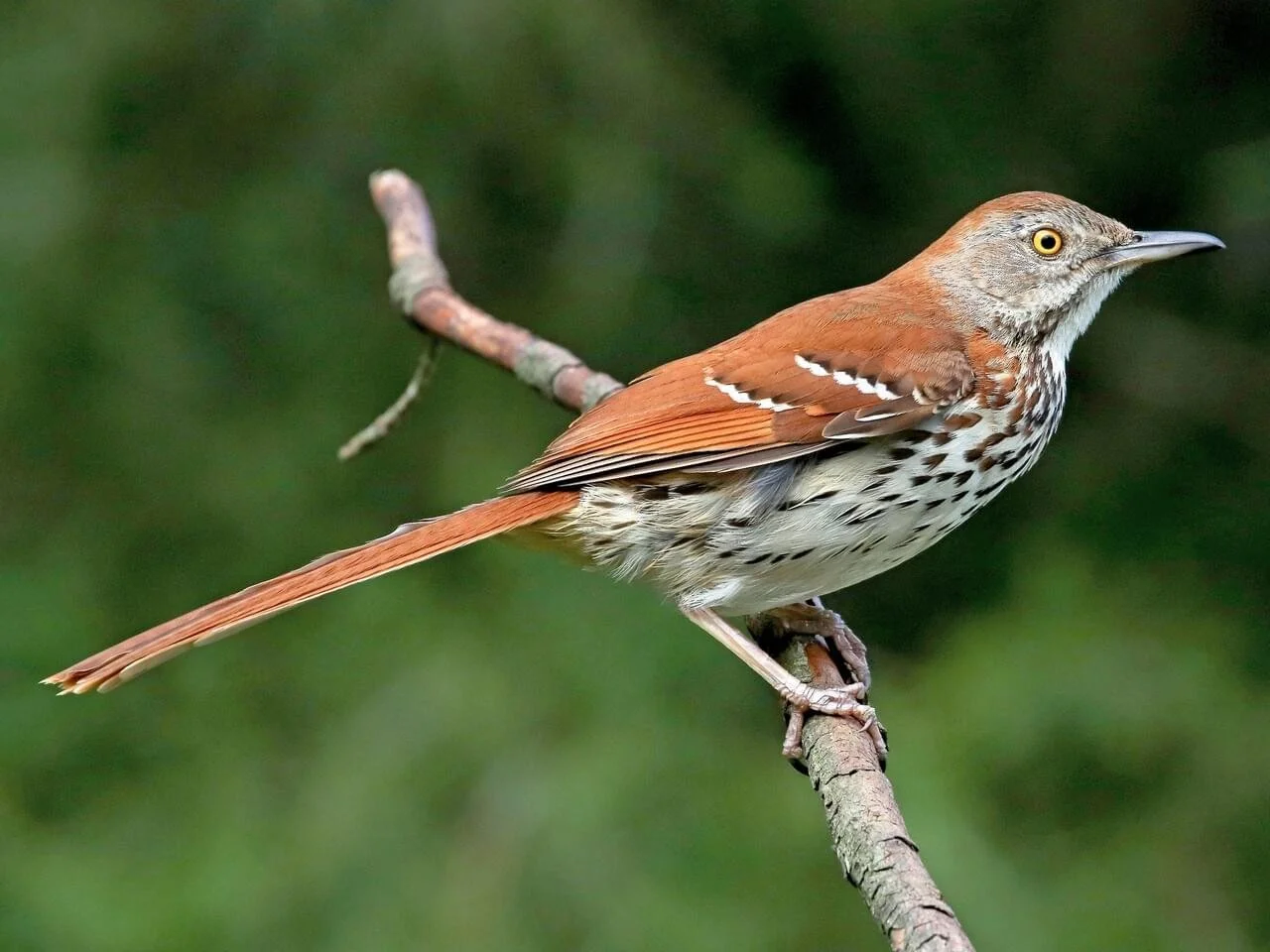
Many of you are fortunate to see Brown Thrashers, primarily in the spring and summer months. Brown Thrashers (BT) are a year round species in TN, however, many migrate short distances which explains why you may not see them in winter. These birds are found in areas with hedges and dense undergrowth where they can forage vigorously on the ground in complete cover. They often move around below bird feeding stations picking up bits of seed and suet while looking for insects.

BT’s are a large songbird with long features. They have a long, curved bill, long legs, and a long tail. They are reddish brown above with narrow black and white wing bars, with prominent dark streaky spots on the chest and belly. To top it off this handsome bird has yellow eyes.

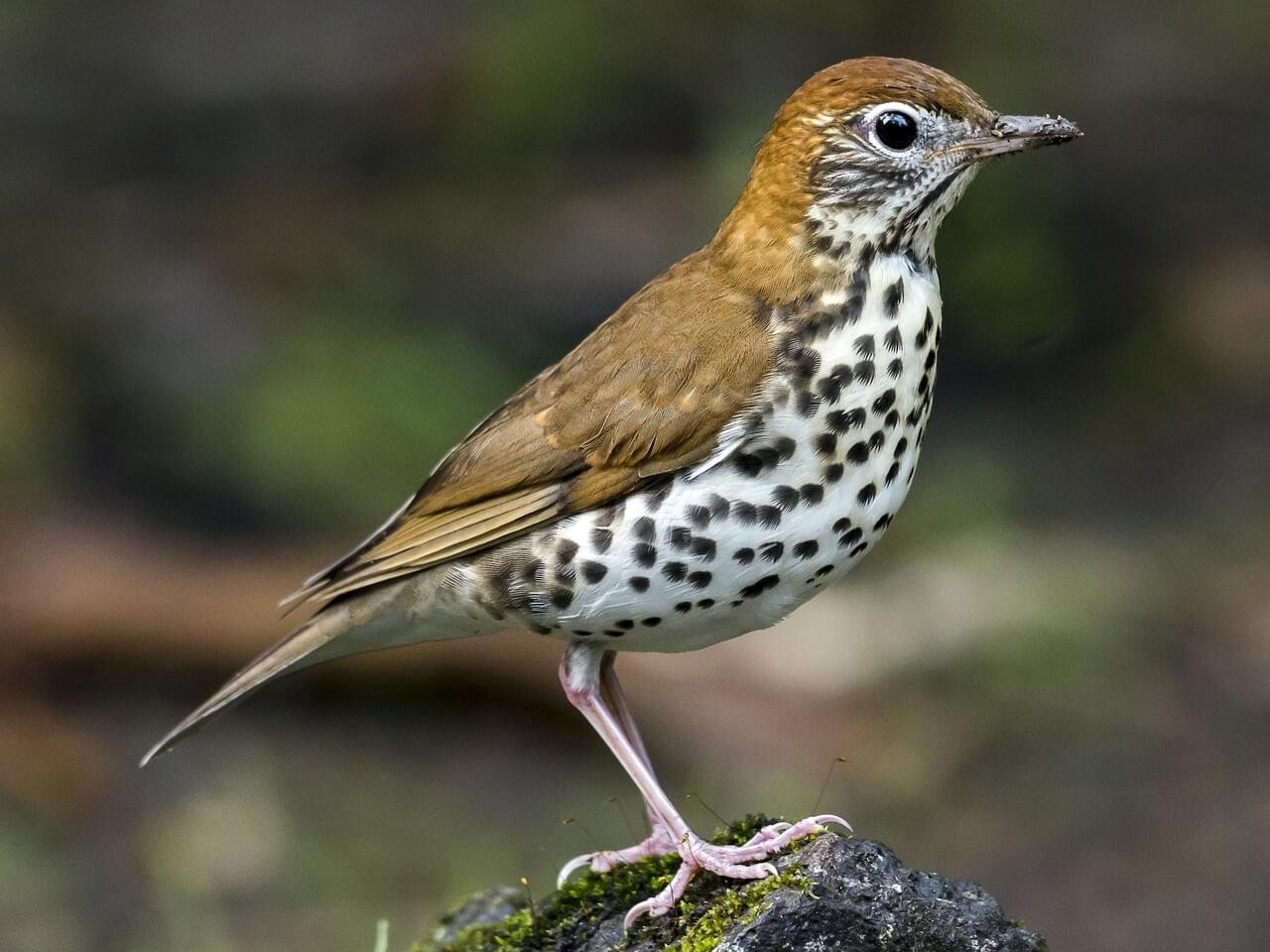
Quite often customers will see a Thrasher and misidentify as a Wood Thrush. While there are some similarities they really are very different in appearance and behavior, too. Always look at a bird with binoculars before coming to a conclusion. A Wood Thrush spends most of its life in the tree tops while Brown Thrashers spend most of their lives on or near the ground. They’ve even been known to nest directly on the ground. BT’s are mostly insect eaters but have been known to consume seeds, nuts, fruit, and even small snakes and tree frogs if the opportunity presents. Occasionally they are seen at suet feeders.

Another very notable thing about Brown Thrashers is they are impressive vocalizers. Their song is a complex string of many musical phrases (many copied from other birds’ songs, with each phrase typically sung twice before moving on). They also make a distinctive, harsh tsuck note.

I hope you are fortunate enough to see these beautiful and interesting songsters in your yard.

Early Summer Hummingbirds

A day doesn’t go by at The Wood Thrush Shop that we are not asked “what’s wrong with the hummingbirds?” “I don’t see any coming to my feeders.” “Are they here”? 

All of our summer resident Ruby-throated hummingbirds are here and well into their first or even second nesting of the season by now.  Like Bluebirds they all don’t start nesting at the same time.  There could be as much as a month difference in the first nesting phase of the earlier arrivals in March and April and the later arrivals in late April to mid-May.

The nesting phase is the reason people generally see far less of hummingbirds now as opposed to mid-July through September when they are seen so readily at feeders.  One must remember hummingbirds do not come all the way from Central and South America for sugar water.  It’s of little need to them during the first half of their summer residency. They are very satisfied with nectar from flowering plants, and insects for protein. Hummingbird feeders are not in high demand at this time and will serve only for quick visits and a brief drink.  When nesting is near conclusion in mid to late July and early August that is when hummers begin visiting feeders with frequency and intensity to fatten up in preparation for the long migration back to Central and South America. 

With that in mind keep fresh nectar in the feeder but do not fill to capacity.  Small amounts are recommended now to decrease waste and major cleaning of feeders.   In warmer weather with temperatures near 90, nectar is only good for 2-3 days at a time.  If your feeder is getting full sun you may want to adjust to a shadier situation or be prepared to change the nectar even more frequently.

Remember to only use plain white table sugar to make nectar, no brown or raw natural sugar, no honey, and no color.  A 1 part sugar to 4 parts water ratio is the perfect solution.  Making it sweeter is no more appealing or beneficial to the birds. 

Be patient, hummingbirds will begin visiting feeders when they are ready.  We should see an uptick in activity around mid-July.


We will be closed Monday, June 19th.

We will see you on June 20th!

Monitoring Bluebird Boxes

It’s great that so many people are interested in providing nest boxes for Bluebirds, and because of these efforts Bluebird populations are extremely robust. We encounter customers, though, that ask a lot of questions they would have the answer to if they just monitored the nest box a little. We do not mind answering the questions, it’s very much part of the job.

Most of the time when we mention to a customer they should consider monitoring the box their response is “I don’t want to disturb them or scare them away”. If done properly neither of those things will happen. Not only is it interesting and a great nature and biology lesson, you can predict within a day or two when the babies will leave the box. And another reason to monitor is you may actually keep something bad from happening to the babies. I’ve often told customers of the time my son, who I taught to monitor, discovered one of our boxes with four two day old Bluebird babies was infested with ants. In just 48 hours, since the last monitoring, ants had found the newborn babies and were likely going to consume them given enough time.

We carefully removed the babies and placed them in a little box, then removed the entire nest from the box while the female watched from a nearby tree limb. We first cleaned all the ants out of the now empty nestbox and made sure no more would climb the pole. Then we constructed a rather poor replica of the nest using their preferred nest material pine straw. After the nest was back in the box we then removed all the ants from the babies by using a drinking straw to blow the ants off and then placed them back in the box in the clean nest. In all it took us about 20 minutes. The female returned to the box about 10 minutes after we completed the cleaning. Even after removing the nest and handling her babies the female came right back to them because the instinct to raise her young is that powerful. So, monitoring which really just consists of taking a peak for a few seconds will definitely not scare the birds away. Bluebirds tend to be quite tolerant of our presence. Usually they patiently watch as I monitor. Once in a while they will swoop at you clicking their beak in protest. But they will not abandon a nest because of brief looks in the box.

Monitoring Tips

  • Observing from a distance is important monitoring, too. Seeing bluebirds come and go is an indication they are showing an interest in choosing the box. If you see the pair on and in the box take a moment after they leave to go look inside. You will likely observe nest building at some point. Pine straw and fine dry grasses are the preferred nest material.

  • Bluebirds tend to lay eggs in the morning hours. The female will lay one per day until done, usually between three and six. Four and five eggs seem to be the most common numbers. She will not begin incubating until all the eggs are laid. So, at this stage I would recommend monitoring in the afternoon so as not to disturb egg laying in the morning. Or, again, if you see the female exit the box take a moment to go look. Take notes. It’s helpful to increasing your knowledge of the process.

  • When I monitor and see 4 eggs and she is not incubating yet that tells me she has probably one egg to go. I will make note of the date because we know Bluebirds incubate for 12-14 days and then should see babies.

  • Once I am certain she is incubating I do more monitoring from a distance. If you see the female exit the box and fly off that’s a perfect time to approach and take a look. Be gentle and quiet. I like a box that has a door that opens down as opposed to up. It is so much easier to monitor in a subtle way. I also take pictures to share with people.

Eggs laid before incubation.

Fledglings days after hatching.

Fledglings about a week after hatching.

  • Now the babies have hatched and I’ve noted the date because we know the babies will take about 14 days to develop and be ready to leave the box. This is known as the fledgling period.

  • I will monitor daily until by my calculations tell me there are just 2 or 3 days to go until they fledge. At this stage of their development the babies may be fearful enough to want to get out of the box if you open it. I monitor from a distance watching the parents as they make repeated trips with food to satisfy all those appetites.

  • Hopefully, the calculations are right and you may get a chance to see babies fledge. You will see more animated behavior from the parents as the first and second babies are about to come out for their first flight. Do not be alarmed if all the babies don’t fledge at the same time. It may take several hours for all to fledge.

For more information about Bluebirds and monitoring please visit the National Bluebird Society website. http://www.nabluebirdsociety.org/bluebirdfacts.htm