
Wood Thrush Notes: All Iron 25% Off, a White Hummingbird in West Meade

Do you have an old, worn out, leaning pole? Maybe your squirrel baffle still works, but its beauty days are far behind it. Or perhaps you’ve been wanting to buy a deck mount pole to really bring those hummingbirds in close, but you keep putting it off. Now’s the time to stop putting it off and finally make it happen… All Erva iron products in the store are 25% now off through Friday, August 22nd! There are several items included in this we want to highlight, so before you tell yourself you don’t need anything metal and scroll down to read about the white hummingbird, at least skim this section!

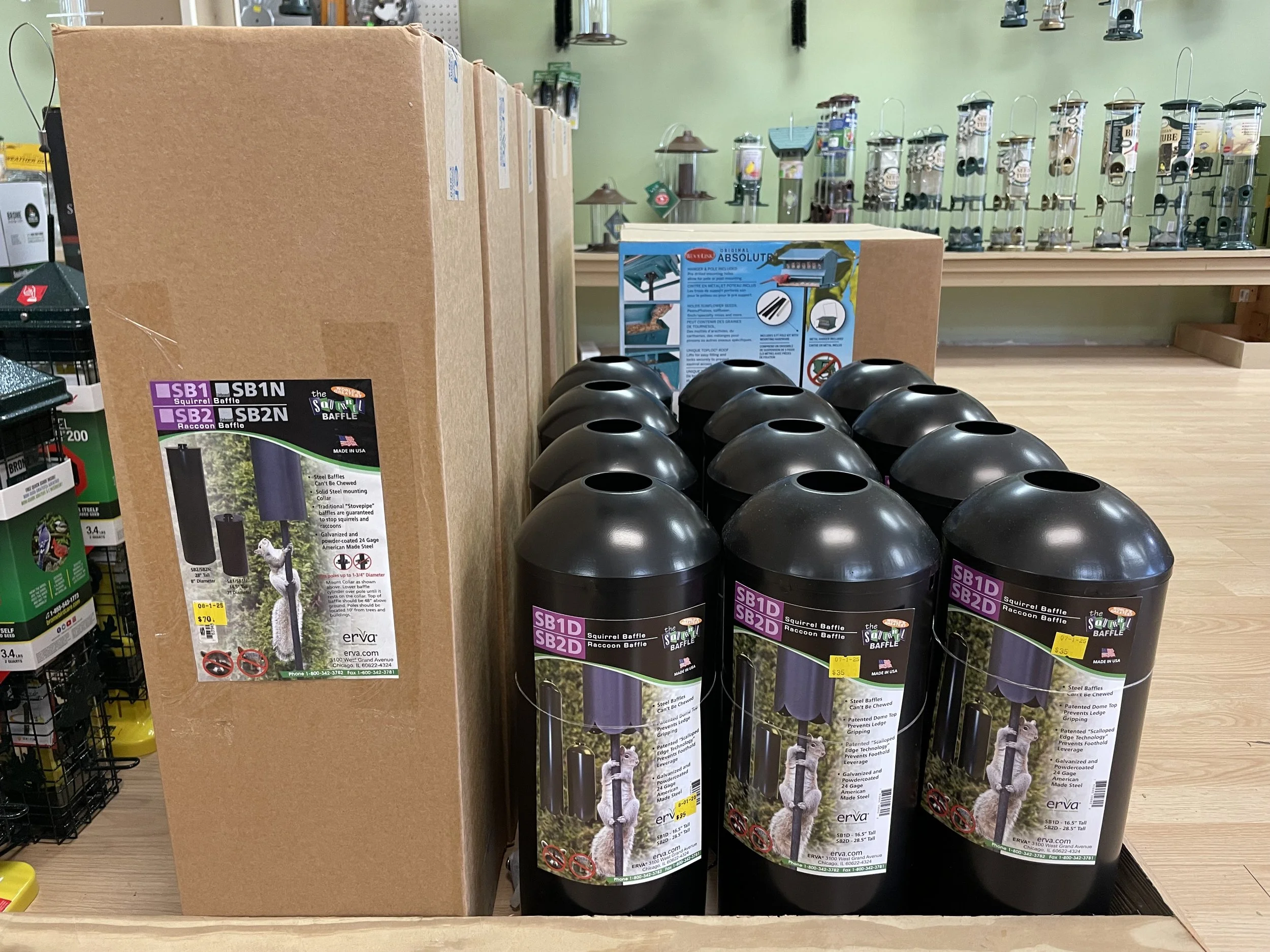
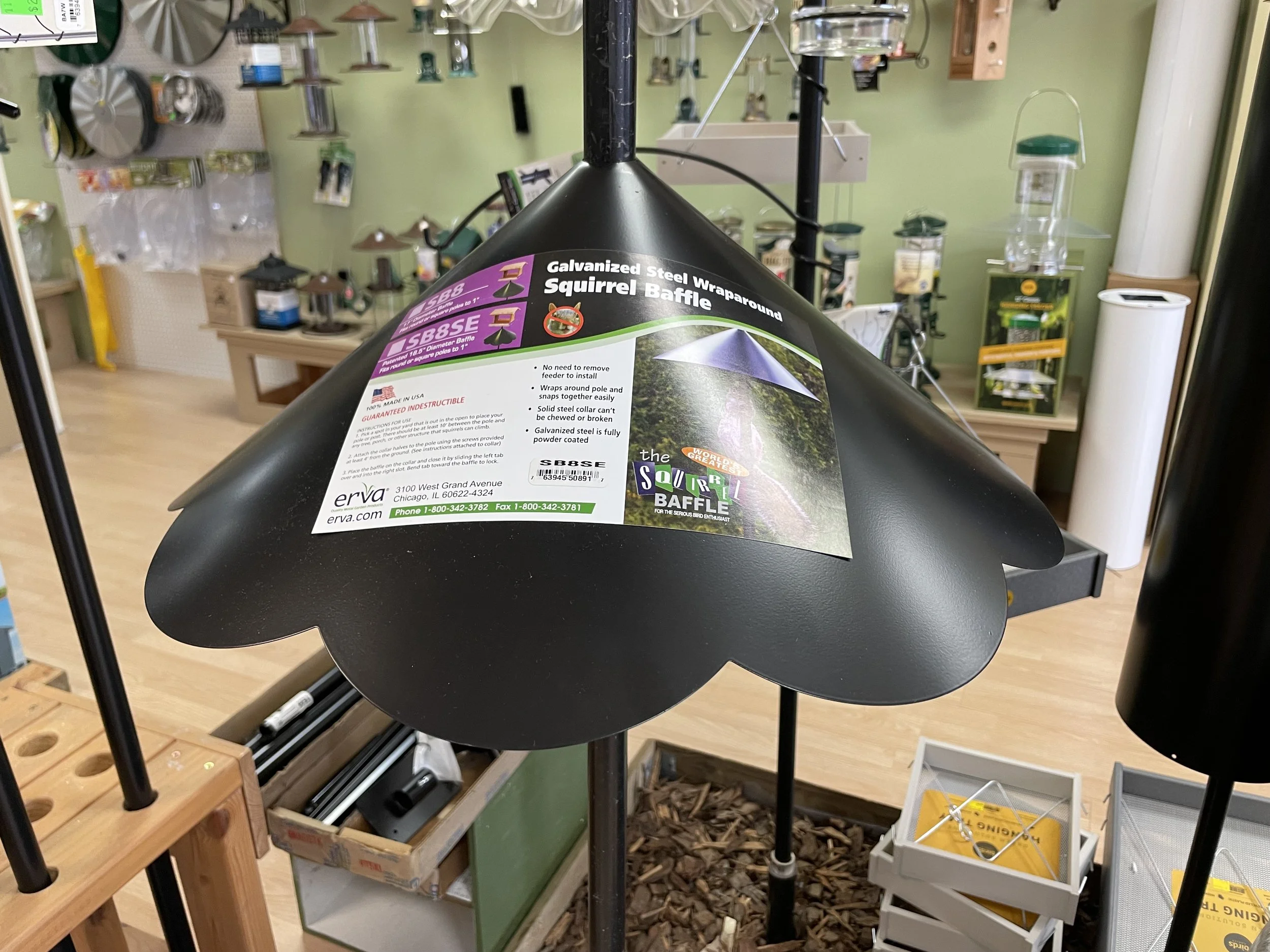
SB1D, SB8, and SB2 Baffles

That’s right! Our baffles are also included in the iron sale. Erva baffles are made here in the USA and built to last. When used in the correct situation, they are 100% guaranteed to keep squirrels and racoons off your feeder. The SB1D is our favorite baffle overall. While all three are equally effective, this one has the lowest profile and therefore will collect the least mess from the feeder above. The only thing to keep in mind is due to the design, SB1D baffles will only work on poles where the top can be removed; they will NOT work on standard one piece shepherd poles. (Fortunately though, all our poles are included in the sale as well!) SB2 baffles look like the SB1D but on steroids. These are the baffles that we can guarantee against racoons. While the SB1Ds will probably keep a racoon off, the giant SB2 certainly will. These are also a good deterrent to keep snakes out of your bluebird box. Lastly, we have the conical SB8 baffle. This wraparound model is the one you need if you are using a shepherd pole. Normally, these baffles are $35, $70, and $40 respectively, although this week with the sale price, they are $26.25, $52.50, and $30!
Hummingbird Feeder Poles, Rain Guards, and Decorative Hooks

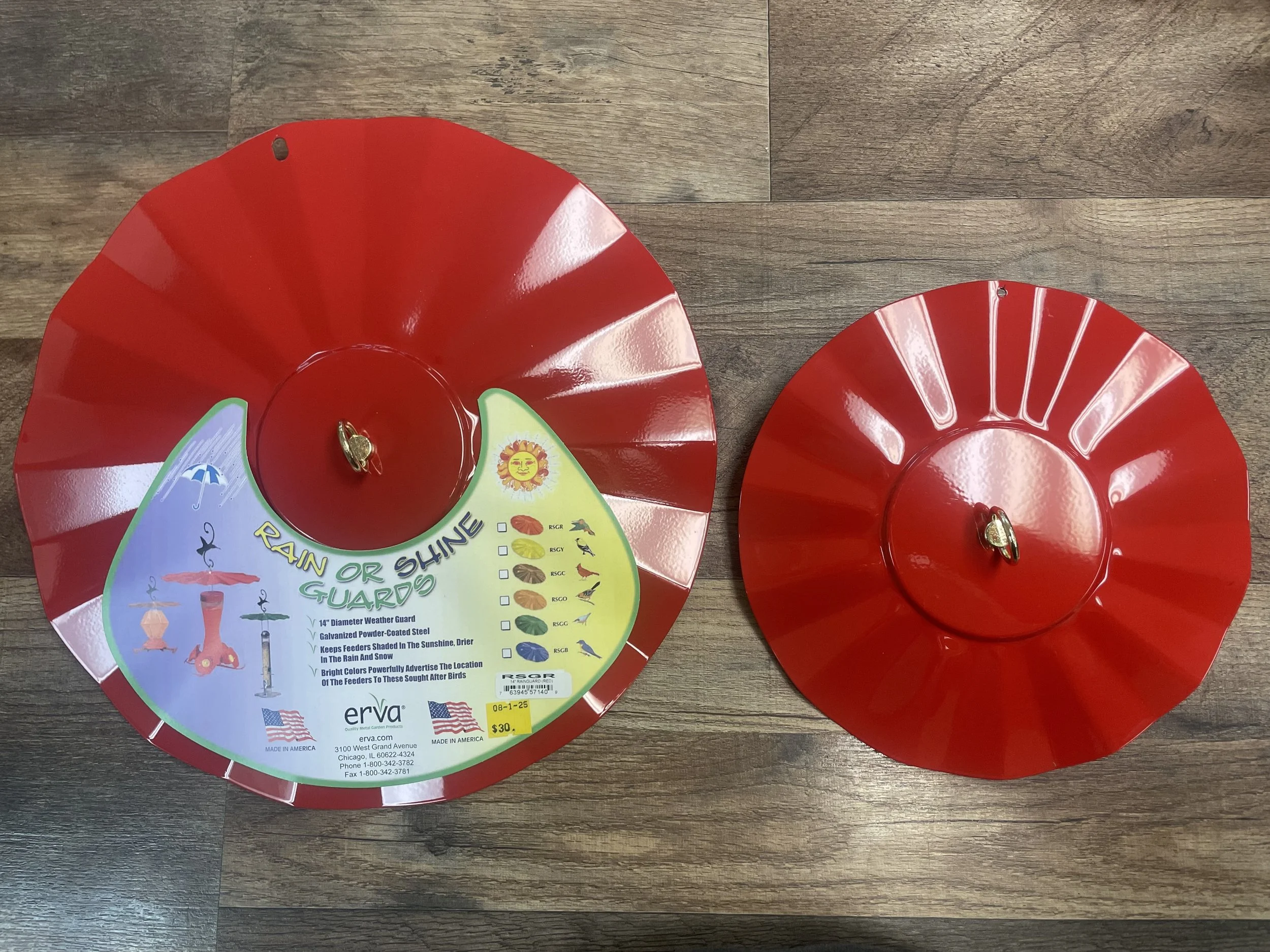
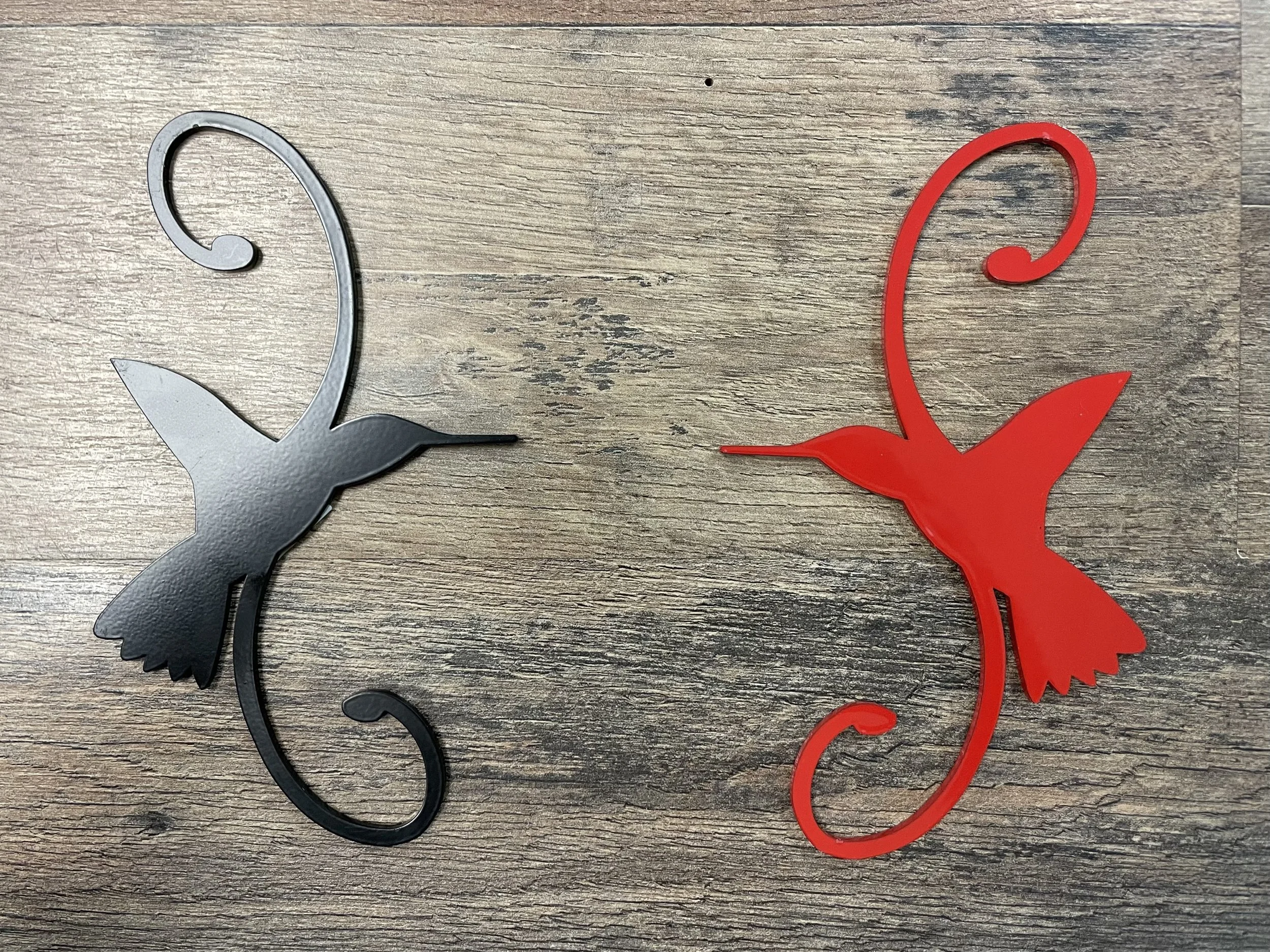
Our hummingbird feeder poles, ($25 for green, $20 for red, $23 for black before discount) metal rain/sun covers, ($30 for large, $19 for small before discount) and decorative (but functional) hummingbird hooks ($13.50 for black, $15 for red before discount) are part of the sale, too! We are currently in the peak of hummingbird activity at feeders, which will continue now through early September. Even after this, hummingbirds will be passing through with regularity into October, so it’s not too late to get your hummingbird feeding accessories.
A White Hummingbird in West Meade

In the past week, we have received multiple reports from customers living in West Meade of seeing something a little… Different. This mystery flier turned out to be a white Ruby-throated Hummingbird! While this is not unheard of, it is quite rare. Most likely it is leucistic, however without being able to observe it for ourselves, we cannot rule out the even rarer albino as a possibility. If you live in the area and have seen this bird, let us know! Email us any photos or videos you are able to get of it to thewoodthrushshop@gmail.com and we will follow up with an update in our next blog!

Happy Birding!

Wood Thrush Notes: Bald Birds and Preventing Bugs in Seed

What’s Going on with that Bird?

Have you recently seen a Cardinal that looks like it went to a barber shop and told the barber to “give me my money’s worth?” You’re not alone! Every year around this time, we begin to hear reports from customers and see examples on our feeders of bald Northern Cardinals, as well as Blue Jays. As odd as they look, we can assure you that this is normal. Typically, it is caused by molting (the process where birds lose and replace their feathers) although in certain cases it can be caused by feather mites. For most individuals, the feathers will grow back within a few weeks, well before the colder nights of late autumn arrive so there is no need for us to worry!

Strategies to Keep Your Seed Bug Free

It’s the time of the year when birdfeeder activity slows down noticeably after the torrid pace of spring and early summer. August thru October is typically when you will see the least amount of activity at your feeders. Why? Because the breeding season is over, and adult birds no longer have young to raise. Feeders are EXTREMELY important to birds while raising young. Rather than roaming great distances in search of food, taking them away from their nests, they make repeated trips to your feeders. With nesting responsibilities concluded they can now afford to broaden their search for more natural food sources, including seeds of plants and insects which of course are in vast supply.

We will often caution customers against buying large quantities of seed at this point in the season. Instead, they may want to reduce their purchase for now knowing that large quantities of seed may sit in a container for a few months which will likely result in a buggy experience. The bug I’m referring to is the Indian Meal Moth. This little brown moth, about ¼” in. in length, loves dry goods such as seeds, grains, crackers, flour, dry pet food, cereal, etc. Because the seed we sell is never treated with pesticides, it is inevitable a few Meal Moth eggs will find their way into a bag of seed. Given time in a warm, safe container, those eggs will hatch and become the next stage of their lifecycle, a larva. The larvae will then cocoon to later become the moth. Thus the cycle begins.

· Buy smaller quantities. During this time frame, when you do purchase a new bag of seed, make sure you use ALL the remaining seed in your container and give it a good rinse before adding the new bag of seed. You want to make sure there aren’t already the beginnings of insect activity.

· Another great option, and this is something we do here at the shop, is run the bag through the freezer overnight. The cold temperatures in the freezer are cold enough to kill eggs or larvae, thus preventing the issue before it can begin.

· Going back to our first point, we highly recommend not buying more seed than you will go through in a month. If you are able to go through the seed faster than that, that’s even better. Besides, it gives you a chance to come by the shop and see us more often!

Wood Thrush Notes: Bird Bio: Osprey, Product Special

Bird Bio: Osprey

Some weeks, deciding on a blog topic prove difficult, with me not knowing what I am going to write about until Friday afternoon. Fortunately for my sanity, not all weeks are like that, and sometimes the topics seem to choose themselves. Last Sunday morning found me in a tent on the Tennessee side of Land Between the Lakes National Recreation Area, staring up at the sky as four Ospreys wheeled in the sky overhead calling at one another. For once, I actually had the right camera and lens combination, so I got myself up and walked to a nearby Osprey nest I remembered finding on a previous visit. (Without my camera)

Sunrise Over Land Between the Lakes

Photo by Eli Haislip

Note: There is another active Osprey nest on the island as of writing this!

The nest was still there, although instead of one bird in it, there were two! I waded out into the water for a better photograph, and while I was there, a third bird flew back to the nest, loudly calling the entire time. My first thought was that this was likely one of the parents returning, however a closer look at its feathers and amber colored eyes (adults have yellow eyes) told me it was another juvenile! Getting to see this spectacle was even better than the cool morning breeze blowing in off the water!

Adult Osprey (left) and Two Juveniles

Photo by Eli Haislip

Back in the comfort of my air conditioned home, I settled onto the couch to begin my background research and my respect for these birds grew all the more! They are quite the accomplished travelers, racking up enough air miles during their life to circle the globe 6 and half times! According to the Cornell Lab of Ornithology, the average individual will log upwards of 160,000 migration miles over the course of its two decade average lifespan. They don’t dawdle, either, with one GPS tagged bird making the 2700 mile trek from Martha’s Vineyard in Massachusetts all the way to French Guiana in northern South America in only 13 days!

Adult Osprey in Flight

Photo by Eli Haislip

Osprey can be found all over the world, from North and South America to Europe, Africa, Asia and Australia. Here in Tennessee, Ospreys typically begin to arrive in early March, stay through the breeding season, and then depart south again in November.

During the spring and summer months, the best places to look for Osprey are along lakes, rivers, and other bodies of water. Unique among raptors, (birds of prey) an Osprey eats almost exclusively fish, with it making up 99% of its diet, according to Cornell. They will soar above the water, sometimes stopping to hover, before diving down with legs and razor sharp talons extended to splash down upon their unsuspecting prey. Most of the fish they catch range between 6-13 inches in length, although the largest recorded osprey catch was a fish weighing 2.5 pounds. Studies show that they have a very high rate of success when hunting, between 25% and 70%. That alone is likely enough to make anybody reading this who has ever dipped a line in the water envious!

An Osprey Clutching Its Catch

Photo by Eli Haislip

Ospreys construct large nests out of sticks, lined with bark, grasses, and algae. They will return to and reuse nests, adding to them each year until the nests grow extremely large; large enough for one of us to sit in! Males generally gather the material for the nest, and the female will then arrange it to her liking.

They will have one brood per year, with it typically consisting of 1-4 eggs. The first chick to hatch will hatch up to 5 days before the rest, giving it a head start over its siblings. In years where there is plenty of food, this doesn’t prove to be a problem, however when food is scarce, the older chick can outcompete its younger siblings. Incubation lasts 36-42 days (for comparison, the Eastern bluebird will have completed one nesting and had time to start on a second in the same amount of time) with the nestling period taking up another 50-55 days.

Osprey Nest

Photo by Eli Haislip

Note the large sticks and twigs making up the body of the nest.

This Week’s Special: Window Mounted Birdfeeders 20% Off

In our opinion, there are few ways that build appreciation for our feathered friends quite like seeing them up close and personal. Normally, this would be where I would pound our Use Your Binoculars drum, but this week, I have another suggestion. Have you ever considered a window mounted bird feeder? These are small feeders that attach to your window by way of suction cups, affording you an up close detailed look at your feeder.

These make a great gift for the kid in your life that loves birds and can’t get enough of watching them. I speak from personal experience when I say with school starting back soon, there’s nothing to get a child through the tedium and mild anxiety of get-to-know-each other activities like knowing they can come home after a long first day of school and observe at a bald Cardinal feeding from 6 inches away.

Maybe you don’t know the kid that I am describing. Do you personally know any cats? Do you have any friends with cats? Window mounted bird feeders go by another name here at the shop… Cat TV. Cats will watch the feeder for hours, mesmerized. Not only will it give them something to do, it generally rubs off on their humans, too!

All our current models of window mounted bird feeders are 20% off through Friday, August 8th, so come by and get yours while supplies last!

P.S.

These also make a great gift for somebody who might enjoy the concept of the different camera bird feeders, but don’t want the hassle of having to keep their feeder charged, connected to WiFi, and creating yet another account.

Wood Thrush Notes: Return of the Sale Table, Product Spotlight, How Birds Survive the Heat

Return of the Sale Table

It’s that time of year again, and our Sale Table is back in all its red stickered glory! While we do our best to find interesting new items that folks will enjoy, sometimes things don’t move as quickly as we’d like and we have to make room for new inventory. Our loss is your gain! Starting this Saturday, you can come by and browse our Sale Table, and be sure to keep an eye out as we will be adding more items to it and running specials on popular items as we move into late summer and fall!

The Sale Table is Back!

Product Special: Butterflies of Tennessee

Summer in Middle Tennessee is a great time of year to observe butterflies and moths. However, if you are like me, too many of these beautiful insects go unidentified. To remedy this, we are running a special on our preferred field guide to the moths and butterflies of our state! We have carried Rita Venable’s Butterflies of Tennessee for a number of years now, and it has remained our favorite butterfly guide since we got them in. It is extremely detailed, with full color photographs of all the life stages of each moth or butterfly, as well as range maps, detailed information, and even tips for what to plant in your garden to attract each species. Today through Friday, August 1st, take 25% off the price marked!

Butterflies of Tennessee by Rita Venable

How Birds Survive the Heat

If you have been watching the birds from the comfort of your (hopefully!) air-conditioned home during this hot weather and wondering how they survive such high temperatures, you’re not alone. Fortunately, much like birds have adaptations that make it possible to survive cold temperatures, the same is true for the hot days of summer.

One simple way for birds to “beat the heat” is by keeping activity to a minimum during the heat of the day. By increasing their activity in the early morning and late afternoon, birds are able to rest and conserve their energy during the hottest hours of the day.

Another way they are able to regulate their temperature is by “panting.” Some species have developed an adaptation known as gular fluttering, which works by rapidly vibrating the moist membranes of their throat, which in turn leads to evaporative cooling. If you’ve ever seen a bird with its mouth open that appears to be panting, chances are this is what it’s doing!

Blue Jay “Panting”

Photo by Eli Haislip

Lastly, one of the best ways for them to stay cool is by taking advantage of water. Be it a cool creek, river, bird bath/fountain, or a post rain-shower puddle, water is an excellent way for birds to cool off. By exposing their skin to the water while they bathe, they are able to dissipate heat quickly and effectively. This is why this is a great time of year to offer water if you are not doing so already. Be it a fountain that provides running water, a traditional birdbath in the shade, or even a planter base or dish with cool water, birds will take you up on offerings of water. (For those of you interested, we even have two fountains on our sale table this year!)

Scarlet Tanagers Enjoying an Andra Fountain

Video Courtesy of Susan Haislip


Wood Thrush Notes: Purple Martin Migration, Add Movement to Your Birdbath, Waterfalls on Sale!

Purple Martin Migration

Purple Martins are already beginning the first stages of their migration back to South America, but before they go, they give the city of Nashville a breathtaking spectacle. Each summer, Martin colonies leave their manmade nest sites after their juveniles have fledged and begin making their way to colony roosting sites in and around Nashville, with numbers starting in the thousands and by August swelling to the hundreds of thousands. For reference, in August of 2024, the estimated high count for Purple Martins at Nissan Stadium was in excess of 200,000 birds.

Nissan Stadium is the best place to see the show, and it also offers the easiest viewing. Depending on events going on downtown, there are ample parking opportunities and it is conveniently close to the interstate. I personally would recommend making sure there are no major concerts or events on the night you choose to go, and also I would recommend not going on a Friday or Saturday night. For those of you that are curious about the spectacle, but don’t think 200,000+ Purple Martins is a good enough reason to venture downtown (we don’t blame you at all!) I will link to a News Channel 2 video here.

Offering Water in Summer

If you are not already offering a water source to compliment your bird feeders, now is a great time to begin! We currently have 8 fountains, over 20 bird baths, and a variety of smaller hanging options so we have something for everybody!

Running water is certainly appealing, but this does not mean that birds will not use still water. Many times after a rain I have watched Robins bathe in puddles in the alley. That being said, perhaps you like the idea of offering running water, but already have an existing bird bath. In that case, we have several options. Our favorite is great for those of you with access to an outdoor power source. The Layered Waterfall Rock is currently our favorite option to add to existing water sources such as birdbaths. It operates using a small pump to recirculate the water, converting your water offering into a fountain with no fuss. Retailing at $65, this is our favorite option.

Our next choice is something that is perfect for those of you with no choice but to have your birdbath in the sun, and with no way to run power to it. The Backyard Essentials Solar Bubbler works well, but, keep in mind it will only work when it is exposed to DIRECT sunlight. Even a cloud passing over or a shadow is enough to slow the pump down to a trickle. Also, it does not store a charge, so it will only work during the daylight hours, not at night. All that being said, coming in at under $30 ($29) it is the most affordable after market moving water option and can more than make up for its shortcomings if used properly.

Lastly, for those of you who neither of the aforementioned options are practical, we have the Water Wiggler. This is the most simple option we have, as well as the ONLY battery powered water mover. Keep in mind, these don’t actually circulate the water; rather the motor turns two small paddles to create ripples on the surface.

Last Chance for the Alpinestone Waterfall!

This weekend only, our Alpinestone Waterfalls are going to be on sale for 50% off! If you have been yearning for the sound of a small stream on your porch or in your backyard, now’s your chance! Saturday only, these waterfall fountains will be $250 off, bringing them down to $250. Don’t let their size fool you, these waterfalls are made of resin and weigh only 50 pounds, making them one of our lightest fountains!