
On a Quest for Loons
A Thank you from the shop
We would like to start things off today by saying we hope that everybody managed to stay safe and warm during our latest winter storm. The outpouring of support and concern we received from you all was above and beyond what we could have hoped for, and we thank you for your support during this challenging time. Luckily for us, while the Westgate Shopping Center was without power, we managed to get by with the aid of a generator which enabled us to stay open, albeit for limited hours. Thankfully, all of us, our families, and our homes are all safe. We hope the same is true for you, too.
Fortunately, power is back to the plaza and we are back to business as usual here at the shop. In all the craziness, we almost forgot that with the month changing to February, it’s now National Wild Bird Feeding Month! Yes, there is actually a month dedicated to what we dedicate our careers to, so it seems like our time to shine! Next weekend, the 13th-16th, is the Great Backyard Bird Count. We will go more in depth on this worldwide bird count that you can participate in in next week’s blog, but stay tuned for possible last minute specials and deals!
White-throated Sparrow
Photo by Eli Haislip
On a Quest for Loons
When your alarm wakes you up at 5am and you find yourself picking your way through the icy patches of your parking lot in the pre-dawn gloom, all so you can drive over an hour across town for a CHANCE to see a particular bird, (not to mention in 22 degree weather) many people will think that you have gone too far. Many more though, ourselves included, will say that you are just getting started!
This is how myself and Jamie’s Thursday began. After meeting at the shop at 06:30, we settled in for the drive out to the Cook Day Use Area at J. Percy Priest Lake. Our quarry for this early mission was a recently reported Red-throated Loon that had consistently been sighted there in the previous days.
If you’re scratching your head, wondering what a loon is doing in Middle Tennessee, you’re not alone. Believe it or not though, Common Loons (the species that likely comes to mind when you think of a loon) are a winter resident to the mid state’s large bodies of water.
Common Loon Preening Itself
Photo by Eli Haislip
J. Percy Priest in particular seems to be a magnet for them during the winter months, where they congregate in loose groups. Common Loons feed by diving for small fish, crustaceans, snails, and various other aquatic invertebrates. You might not guess it by watching them in flight or on the surface, but they are powerful and graceful swimmers, able to change direction underwater on a dime in order to catch their fishy prey.
The species we went in hopes of finding was the Red-throated Loon. Whereas the Common Loon has been described as a “bruiser” by comparison, the Red-throated is slimmer and overall more elegant in appearance. They also have a slimmer, upturned bill. Red-throated Loons generally spend the winter along the coasts, and breed in the high arctic during the summer, making the appearance of one here in Davidson County worth the frosty, early morning drive.
When we arrived at the boat launch the bird had been reported around, despite our layers the cold caught us off guard. There was a biting breeze coming in off the water, and the skies were overcast and gloomy. It was so cold that there were even flurries floating around. All this to say, the conditions were making us wish we were still in bed. However, our spirits lifted when we saw the unmistakable floating silhouettes that could only be loons!
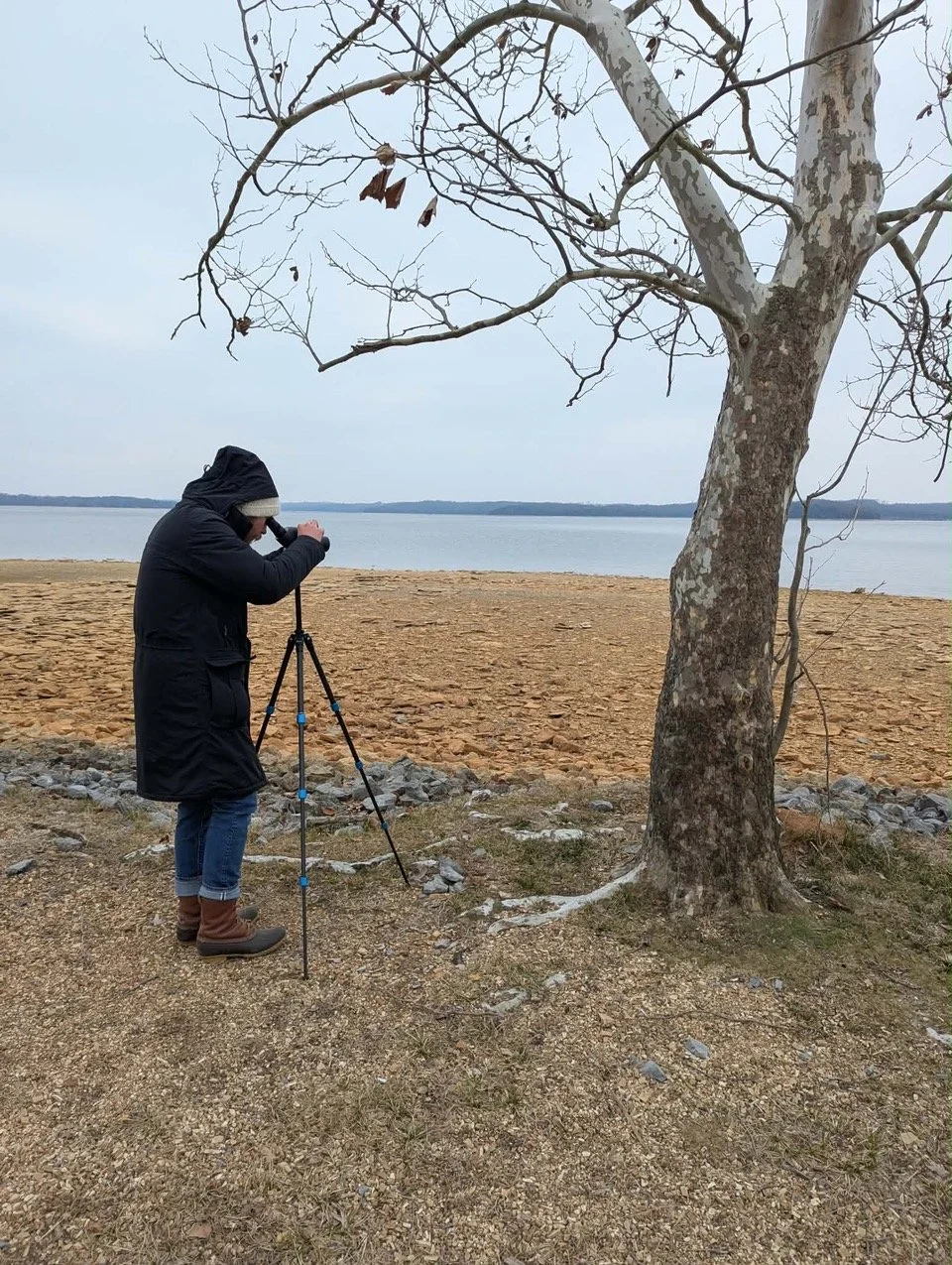
The Author Scanning for the Red-throated Loon While His Hands Go Numb
We counted 13 individual Common Loons in our particular area. We arrived at around 07:15 in the morning, and most of the birds were staying fairly still while preening themselves, which enabled us to get a good look at them. While we were watching them and discussing how little we would want to be in the cold, gray water, our hands were turning red from the cold. I thought I had forgot my gloves, which was only partially true. In reality, my gloves were nice and warm in the inside pocket of my coat that I forgot existed. It was even so cold that my camera was glitching again, and not allowing me to take more photos. Seemingly it had more sense than we did and wanted to be back inside. Unfortunately for us, the Red-throated Loon was not amongst the group that was in our part of the lake. We saw from a great distance (too far for an ID, even with my 30x magnification spotting scope) another large group of loons, in addition to gulls, further down the lake near an area known as Seven Points and while we didn’t have time to go down there that day, I plan on returning over the weekend to investigate both areas further. If I am successful, I will add a follow up to next week’s blog!
Common Loon
Photo by Eli Haislip