
BIRD NEWS BLOG
Breaking News…Hummingbirds Are Not Coming This Year
Due to recent changes in immigration laws, and because of their aggressive nature and known drug trafficking activities Ruby-throated hummingbirds will not be allowed to cross the border into the U.S. this year. Many hummingbirds have been used as “mules” transporting small packages of drugs attached to their little bodies. Put away your hummingbird feeders because they won’t be needed. April Fools!
Migratory Birds Being Seen this Week
This is the most exciting time of year for birdwatchers as migration brings neo-tropical songbirds into and through TN from Central and South America. As of this morning here is a summary of what has been seen in our area this week:
Black and white warbler, Yellow-breasted chat, Black-throated green warbler, Chimney swift, Northern Parula, Blue-gray gnatcatcher, White-eyed vireo, Yellow-throated, Palm, and Yellow-rumped warblers, as well as Pine and Hooded warbler. The best time to look for these birds is in the first 4 hrs. of daylight because they migrate at night and settle down to rest and feed in the mornings. Without leaves on the trees yet there are far less obstacles for viewing.


For detailed up to date sightings and the locations to find and see birds download the E-bird app, or visit ebird.org
Swallows: The Early Spring Migrants
The earliest of the spring migrants, birds returning from Central and South America, include a few birds of the swallow family. Purple Martins, Tree, Barn, Cliff, and Rough-winged swallows are some of the earliest to return to middle TN. A recent outing on the Harpeth River revealed several Cliff swallows feeding over the water and flying up and straight into the amazing gourd-like mud nest they build on bridges.
Cliff Swallows have broad, pointed wings, a metallic dark blue back, pale cinnamon colored rumps, and rusty brown faces with a white patch on the forehead.
Like Barn swallows and Purple Martins these birds are colony nesters and it is normal to see hundreds of these structures clustered together. Over 3,000 nests have been seen in one place. When young Cliff Swallows leave their nests they congregate in large groups called creches. A pair of swallows can find its own young in the creche primarily by voice.
Obviously, they are very social, not only in their nesting habits but feeding as well. You may see hundreds of these birds feeding together when a particularly good swarm of insects presents itself. In fact, if a Cliff swallow finds a good source of flying insects it has a specific call to alert the others.
To find this bird look at any bridges crossing the Harpeth River. There’s a good chance you will see these busy little birds feeding and coming and going from their amazing nest structures.
Wood Thrush Notes
Spring is officially here as of this Sunday! So much, in regards to birds, is happening and will only get better and more interesting in the coming weeks. Yesterday, I checked all nest boxes on my property and found 2 Chickadee nests started, and 1 Carolina Wren nest complete, but no eggs yet. Bluebirds have been trying to decide which box to use and in past years I’ve seen this process go on until mid-April before a decision was made. Many times Bluebirds eventually moved into one of the boxes Chickadees successfully fledged their babies from.
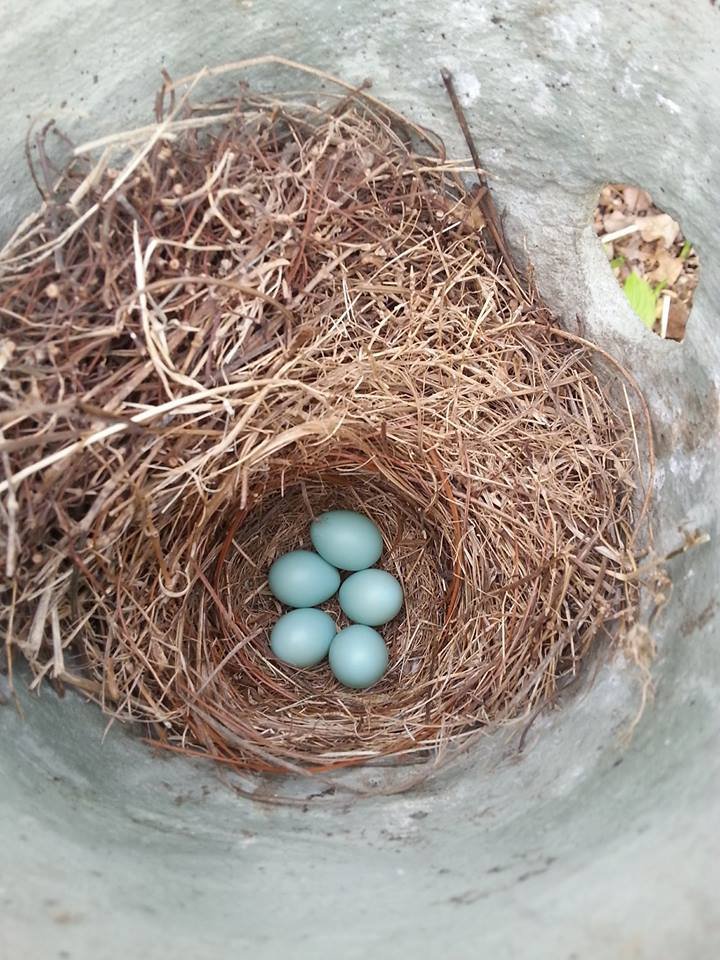
Eastern Bluebird nest.

Carolina Chickadee nest.
We’ve only had one reported Bluebird nest with eggs so far, which is quite normal as the majority of Bluebirds do not start actually nesting for another couple of weeks. You still have plenty of time to attract Bluebirds even if you haven’t put a nest box up yet. For success this spring I wouldn’t wait much longer, though. All too often people new to attracting Bluebirds think they must offer mealworms to attract Bluebirds, which is not true. It’s certainly fun to feed Bluebirds but not at all necessary to the process. Some of you may already be seeing Tree Swallows as they have become frequent users of birdhouses.
The first Ruby-throated hummingbirds to arrive in this area are probably just a week to ten days away. As exciting as that is I would not advise putting out several feeders just yet. One feeder with a small amount of nectar will suffice as their interest in feeders is minimal at this time of year. Keep in mind the hummingbird you see may very well be migrating much further north to its summer home, perhaps as far as Canada. Let us know if you see one. I have never seen one earlier than April 4 at my home in Cheatam County.
As we approach mid-April we will experience the main period of migration in middle TN. Warblers, Vireos, Flycatchers, Wood Thrush, Summer, and Scarlet Tanagers, and Orioles, will be present as they settle into their summer home here or move on to destinations north of us.

Indigo Bunting.

Rose-breasted Grosbeak.
At your feeders be ready for Indigo Buntings and Rose-breasted Grosbeaks. R-B Grosbeaks are especially fond of visiting feeders with sunflower and safflower. While a platform feeder may be their preferred feeding situation they adapt very well to tube feeders as well.
This week it was noticeable that Goldfinches are changing out of their drab winter outfit in to their beautiful yellow summer plumage.
I’m so glad spring is here, aren’t you!?
Goldfinches and why you may not have success with them.
We have really been fielding a lot of questions about Goldfinches lately. Mostly the question is “why am I not getting Goldfinches”? There are a lot of possible answers to this question so let’s look at some things to be mindful of as it pertains to finches and your finch feeders.
Goldfinches are very different than the usual cast of songbirds visiting your feeders on a daily basis. Goldfinches (GF) travel in flocks from small to large, and I mean travel. GF’s may move several miles a day in search of good reliable food sources where, once found, may stay for a few days, or longer until they go in search of more.
Make sure the seed in your finch feeder is in good condition. If it’s wet and clumped they will keep moving. A weather guard is a really good idea during wet winter and spring months. Goldfinches are very happy to feed on natural food sources so the seed in your feeder better be in good condition to get and keep their attention.
Because they move and feed in flocks your finch feeder should be topped off regularly to accommodate several birds at once. They prefer to feed in groups. Also, you will likely have better results if your finch feeders are grouped and not separated.
Nyjer is not the only seed GF’s will feed on. In fact, we are of the opinion GF’s prefer sunflower seed. They show a strong preference for black oil sunflower in or out of the shell, or our Finch Blend and Fine Sunflower Chips.
Keep in mind many GF’s are migratory. Spring and fall migration tends to be a time when these birds are really on the move and disappear from feeding stations seemingly overnight. Be patient and pay attention to the quality of your feeders and seed because they will return and reward you with their beautiful spring-summer plumage.
Great Backyard Bird Count & Recent Bird Sightings
Coming Soon. The Great Backyard Bird Count.
Once again the Great Backyard Bird Count is just a few weeks away, February 18th thru 21st. The GBBC is a worldwide online citizen-science project, the first of its kind, to collect data on wild birds and display results in near real time. It was launched in 1998 by the Cornell Lab of Ornithology and the National Audubon Society.
Our observations and data help scientists better understand global bird populations before one of their annual migrations.
Visit www.birdcount.org/about/ for more info on the count!
It’s fun and easy to participate and all you need is a birdfeeder or two. Information and instructions are available through the link provided. The 3 steps to participating are as follows:
Step 1 – Decide where you will watch birds. Easy enough. Your backyard works just fine.
Step 2 – Watch birds for 15 minutes or more, at least once over the four days, February 18-21, 2022.
Step 3 – Count all the birds you see or hear within your planned time/location and use the best tool for sharing your bird sightings:
If you are a beginning bird admirer and new to the count, try using the Merlin Bird ID app.
If you have participated in the count before, try eBird Mobile app or enter your bird list on the eBird website www.ebird.org (desktop/laptop).
If you are participating as a group, see instructions for Group Counting.
We hope you will participate and present your data for a very worthy study.
Recent Bird Sightings of Interest
Locally, a number of customers have seen Pine Warbler at suet feeders during the recent snow falls. They are one of the few warblers to be seen here in winter. Others sometimes seen at feeders include Orange-crowned and Yellow-rumped warblers.


Elsewhere in the state, bird sightings of particular interest include a Painted Bunting being seen consistently in Knoxville. Painted bunting, like Indigo bunting, usually migrate back to Central and South America in the fall and return in the spring.
Great Horned owls on Nest
You may not know that Great horned owls begin nesting as early as mid-January and February in southern parts of the U.S. Clutch size of GH owls is between 1 and 4 eggs and it takes 30-37 days to incubate. The fledgling period takes roughly 42 days. Pine trees are often a favorite choice of nesting location as are cavities in live trees, dead snags, deserted buildings, cliff ledges, and man-made platforms. I once witnessed a GH owl nest on a cliff-ledge along the Harpeth River.
The video below is taken from a live stream of a GH owl in Savannah Georgia. Click here to link to the live stream.