
BIRD NEWS BLOG
Wood Thrush Notes
Fall Migration and BIRDCAST
Fall Migration is underway and while your seed and suet feeders will typically slow down now through October, birdwatching in the area will be significantly more interesting because migration is in full swing.
When spending time outdoors have your binoculars with you and ready because Warblers, Tanagers, Orioles, Rose-breasted Grosbeaks, and Flycatchers are pouring through middle Tennessee stopping to feed in the mornings on insects and berries, and at birdbaths. Pay particular attention to birdbaths and fountains as many of these birds seek out good water sources to take advantage of.
Mornings are best to see lots of different species because most migrants are traveling at night. They settle down to rest and feed in the morning.
Look for large if not massive flocks of Chimney Swifts and Common Nighthawk in the evenings commonly seen in areas near downtown or where there is ample night lighting like high school football games.


BIRDCAST
Did you know that radar used to track weather systems is also used to track bird movements? I suggest you check out BirdCast at birdcast.info. BirdCast is a project of the Cornell Lab of Ornithology, Colorado State University, and the University of Massachusetts Amherst. BirdCast applies weather surveillance radar to gather information on the numbers, flight directions, speeds, and altitudes of birds aloft in order to expand the understanding of migratory bird movement. Just last night, Sept. 28, an estimated 956,000 birds flew over Davidson Co.! And that number will increase as we approach the usual strongest time of migration in the month of October. BirdCast has live migration alerts in real-time and even projects what species are most likely flying over us on a given night. Their findings have been eye-opening and very interesting, to say the least. To summarize all the interesting information provided by BirdCast would be impossible. I urge you to check out this site. Wonderful!
Wood Thrush Notes
End of Summer-Early Fall Notes
We have received more than a few calls recently regarding the very noticeable slowdown at feeders in recent weeks. The degree of slowdown may vary each year but without a doubt September and October are the two slowest bird feeding months of the year. My 28 years of tracking sales data backs this statement up. We always sell far less seed and suet during these two months. So why does it slow down?
There are two reasons why feeder activity slows down at this time. Feeder activity is at peak level during the breeding-nesting season, between the months of March and July. We get used to the abundance of birds visiting our feeders and many of us are filling feeders frequently, every other day if not more. While nesting and raising young birds take full advantage, but do not rely on our feeders. Raising young takes a tremendous amount of energy and rather than having to forage for food at greater distances they will increase their visits to feeders exponentially, thereby staying closer to the nest and their valuable offspring. And many of our feeder birds will nest twice per breeding season. So, the first reason for the slowdown is the breeding season for our year round and summer resident birds has long been over, for at least a month and a half. The need for “extra” food has passed.
The second reason is by the end of summer and beginning of fall plants are producing seeds, nuts, and fruit. Beneficial insects chocked with protein are still very much available. Instinctually, birds cannot pass up the abundance of natural foods and variety now available. Therefore, the feeders that were important to them in the spring and summer become less important now. With no young to attend to they have little to do but feed on what nature is offering and to cache food for later use. Sure, you will still get birds visiting your feeders but not like during the breeding season. This would also explain why we rarely see Rose-breasted Grosbeaks at our feeders in the fall on their return trip to the tropics, when they are such prominent feeder birds in spring. Natural food is everywhere and unless something occurs to prevent food production, like a drought, birds will gravitate to it before going to feeders.
As much as the business owner side of me hates to see the slowdown I also appreciate the opportunity to point out birds do not rely on or survive on our feeders, as many people mistakenly believe.
Experience says by mid-November, or earlier if there are a couple of good frosts, you will see a return to busy feeders. So, don’t think something has happened to our birds. It really is just birds being wild animals acting on thousands of years of instinct. They will return to your feeders. By the way, this slowdown is a great opportunity to give your feeders a thorough cleaning.
Molting
Have you been finding feathers around your yard, or maybe seen some really funky looking Cardinals or Bluejays recently? Seeing Cardinals or Jays with an alarming lack of feathers on their heads is quite common after the breeding season.
Molting is the process by which birds lose damaged or worn out feathers with new ones providing them not only with healthy new feathers but often a new look to their plumage in the form of new colors or patterns that may indicate a bird’s age, sex, or season of the year. Feathers are comparable to our hair or nails made from the same basic ingredient, keratin.
Molt is not a “one size fits all” occurrence. There is great variation by species and even by individual from year to year. While molt is associated with this time of year any time a bird loses a feather a new one will immediately begin to grow in its place.
Occasionally, Cardinals and Bluejays will lose all their head feathers in a short amount of time and while it takes a while for the new ones to grow in the result will be a bald bird. I’ve seen a number of male Cardinals recently that were in between bald and the emergence of new feathers. They look rather odd as their heads under the feathers are dark gray to black.

Molting Cardinal
Hummingbirds Getting Plump
I’ve seen some chubby hummers at the feeders lately as they continue to feed heavily and store fat for their long journey. There’s plenty of time remaining to enjoy hummingbirds as they prepare for their return to Central and South America. While you may have already seen a reduction in numbers of hummers at your feeders keep in mind Ruby-throated hummingbirds continue to head south from as far as Canada. These very birds may show up at your feeders at some point weeks from now so keep the fresh nectar coming and your feeders clean. Earlier in September I was in Maine and had several sightings of hummingbirds. Isn’t it amazing when you consider the distance traveled by these little dynamos?

Evening Bats
For 5 years now my wife and I have enjoyed the presence of bats in a “Rocket house” built by a customer–friend that traded it to me for some bags of birdseed. I have to say I got the better end of that deal. Those bags of birdseed are long gone, however, the bat box is a source of fun and interest between March and October as our bat population has grown to over 250 now.
Only this spring we learned they are known as Evening bats, Nycticeius Humeralis. We were able to connect with a person from the Tennessee Nature Conservancy who came to our home to observe the bats exiting the box. He filmed them and used a sound device that records and translates their “calls” to sonograms. Each bat species’ call has a unique and identifiable sonogram. During his visit we counted approximately 150 bats leaving the box.
Then came the night of June 9th and we were watching the bats emerge when we saw something fall from the box and not fly. Upon a closer look I was shocked to discover a baby bat, perhaps just a day or two old clinging to the post the box is mounted on. We suspected but now had proof our colony of bats are females raising babies.

Baby Evening Bat.
The Evening bat is an abundant bat throughout the southeastern US, north to the upper Midwest and Ontario, and along the Atlantic seaboard into Florida.
The evening bat is almost never encountered in caves and is considered a forest bat. It forms nursery colonies in hollow trees, sometimes in buildings and attics, and fortunately for us, in bat houses. Some maternity colonies are quite large, containing several hundred individuals. Evening bats emerge soon after dusk and forage on a large array of small nocturnal insects including flying ants, Japanese beetles, June beetles, and moths. Take note mosquitos were not mentioned. While they may eat mosquitos when encountered, bats are typically feeding at a more elevated level while mosquitos are closer to ground level.
In the fall, evening bats store large amounts of fat for a potentially lengthy migration to southern parts of their range. In a banded bat recovery study, evening bats were found as far as 300 miles south of their banding sites. Still, little research has been done to learn the exact migration movements of this species. The bats have not been found hibernating in local caves and simply disappear from their summer habitat. Once these bats have arrived at their wintering sites, they are thought to remain active throughout the winter.
Breeding occurs in the fall, and delayed fertilization allows for the birth of 1-2 young in late May through June. Young begin to fly after 3 weeks but continue to nurse until 6 to 9 weeks.
On another recent evening as we watched the bats emerge one flew directly toward us somewhat awkwardly and as if it realized it had made a mistake crash landed onto the deck between us.
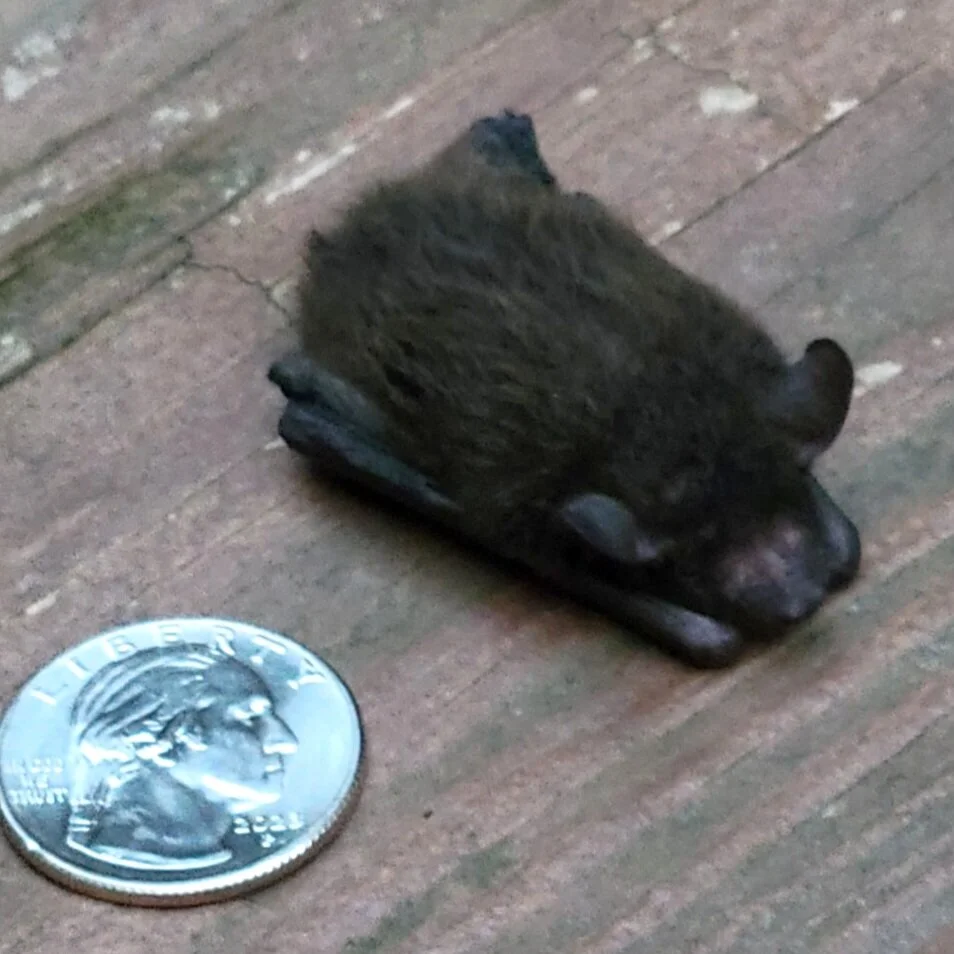
The picture is the young bat aside a quarter I placed next to it for perspective. I assisted the little bat in getting back to the post where it climbed up into the box safely. From our counts earlier in the spring of around 150 to our counts now of over 250 it’s reasonable to conclude we are seeing over 100 offspring. Clearly there is some overcrowding and we are going to add another Rocket house nearby to, hopefully, encourage more. Other bat houses are good, too, and I recommend visiting the websites below to learn more. It’s interesting that the more we learn about these docile, beneficial, creatures the more questions we have. We hope to continue cultivating the success we are experiencing and learn much more in years to come.
Other species of bats seen in TN include Brazilian free-tailed, Eastern pipistrelle, Eastern Red bat, Eastern Small footed, Gray, and Hoary bat.
Wood Thrush Notes
Store Schedule Alert
The Wood Thrush Shop will be closed Wednesday, July 26th.
Late Summer Bird Feeding Notes
Goldfinches are on nest now so if you are seeing more, or less at your feeders, that could be the reason. They of course begin nesting much later than other songbirds probably because they are exclusively seed eating birds. A lot of natural seed forage will be present about the time baby Goldfinches start leaving the nest helping them to sustain life for the first several months. Goldfinches can have 2 broods per year.


There are most definitely peaks and valleys to the bird feeding year and we have always recognized spring and the first half of summer as the busiest segment, even more than winter. Why? It is most certainly because during the spring-summer breeding season nesting birds take full advantage of our feeders. As they expend a lot of energy raising young they are able to feed themselves without the extra effort of having to search for food. But as the breeding season comes to an end and babies are now mostly on their own, feeders are not as important in their daily lives. Insects are the most plentiful food right now and this bounty will be present for the next several months to come. Without young to care for, naturally, our seed feeders will slow down from the torrid pace we’ve seen since April. Gradually, feeders become less important and when October arrives we will experience the slowest bird feeding month of the year. In October every plant and tree has produced nuts, seeds, and fruit. There is more food available at this time than they know what to do with. Well, actually, they do know what to do with it. They will feed mainly on what nature provides and many songbirds will begin caching food away in hiding places. Chickadees have been known to cache food in as many as 200 different locations and remember them. Insects are still available, too, which means our feeders become pretty uninteresting.
Anyone who thinks birds become dependent on feeders doesn’t really understand birds. While they take advantage of feeders during critical times of the year; breeding season, extreme weather, etc., they by no means become dependent and there really is no evidence to support that claim. If birds became dependent why do, for example, Rose-breasted Grosbeaks always leave us in the spring? We see them at our feeders for as much as a month, why do they not stay? Instinctually, they must go. They are, in a way, programmed to go to the breeding grounds they have gone to for thousands of years. Furthermore, because of all the natural food sources available in the fall Rose-breasted Grosbeaks rarely visit our feeders on their return to the tropics. Same thing with hummingbirds. They won’t stay here because we offer them sugar water. They do not become dependent.
Over the next few months as you buy seed you may want to buy smaller quantities knowing feeders will be slower, and avoid bug issues in the process. Storing seed for months in warm conditions can result in a buggy surprise in your seed container. The Indian meal moth is a common problem in all kinds of products, including dog and cat food. Storing smaller quantities of seed in a cool environment is the best way to avoid these troublesome insects. If you happen to notice some insect activity in your seed you can simply put it in the freezer overnight, or use the remainder of the seed immediately. The seed is not a danger to the birds and the little moths and their eggs are just another source of protein.
Bird Bio: Brown Thrasher
Holiday Store Hours
The Wood Thrush Shop will be closed Monday and Tuesday, July 3rd and 4th. We hope you have a fun Independence Day weekend. See you Wednesday the 5th.
Brown Thrashers
Many of you are fortunate to see Brown Thrashers, primarily in the spring and summer months. Brown Thrashers (BT) are a year round species in TN, however, many migrate short distances which explains why you may not see them in winter. These birds are found in areas with hedges and dense undergrowth where they can forage vigorously on the ground in complete cover. They often move around below bird feeding stations picking up bits of seed and suet while looking for insects.
BT’s are a large songbird with long features. They have a long, curved bill, long legs, and a long tail. They are reddish brown above with narrow black and white wing bars, with prominent dark streaky spots on the chest and belly. To top it off this handsome bird has yellow eyes.
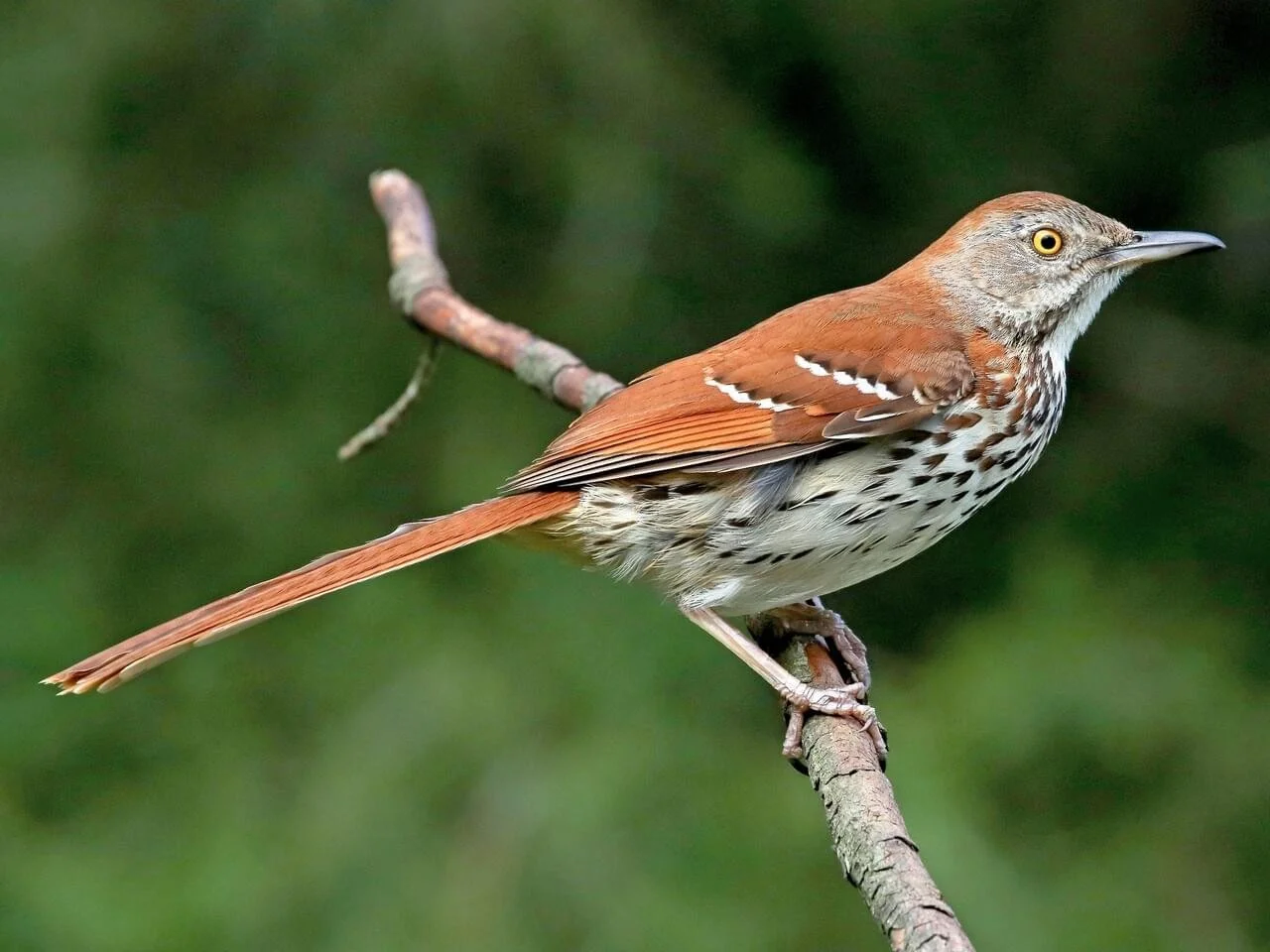
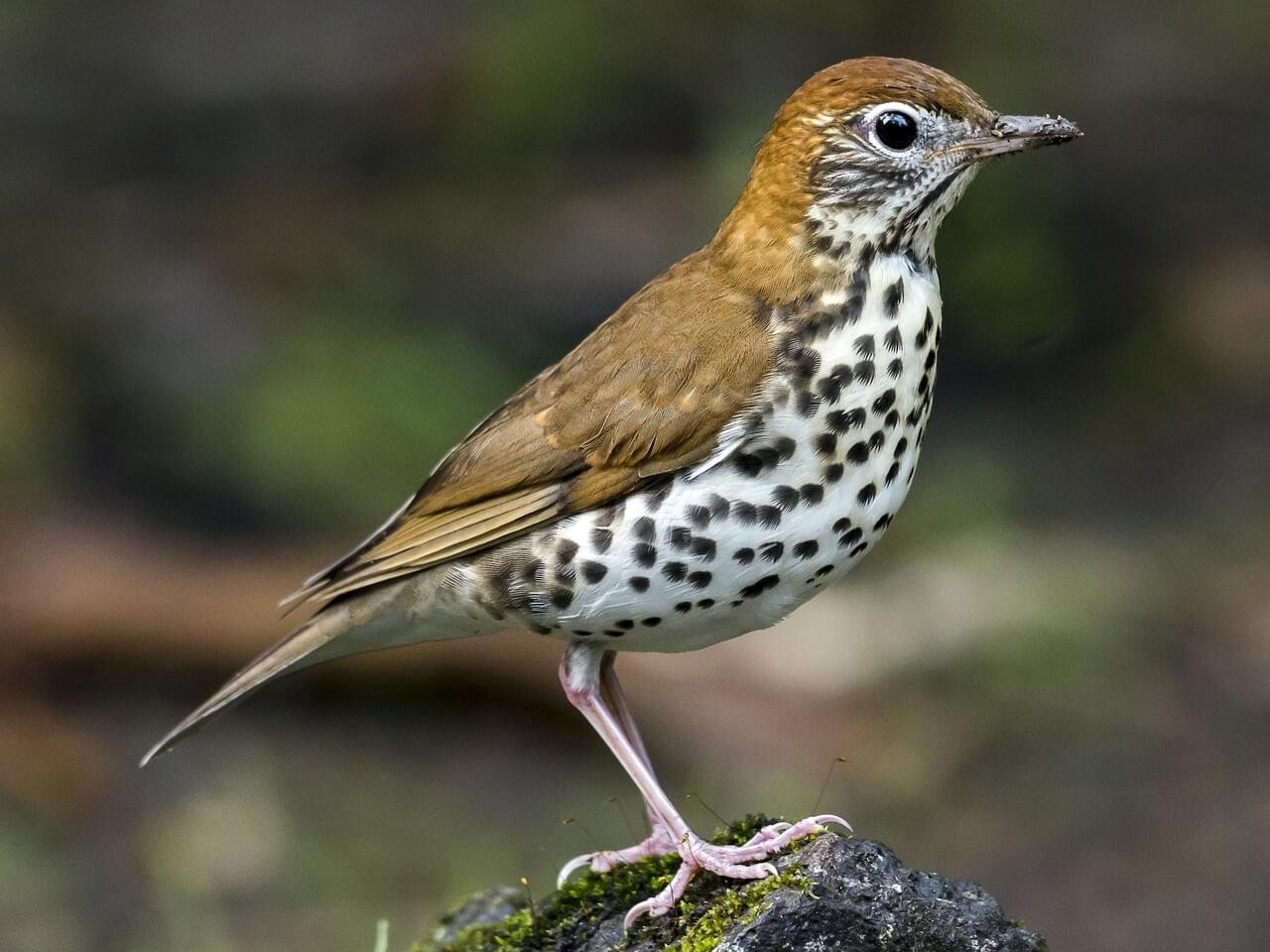
Quite often customers will see a Thrasher and misidentify as a Wood Thrush. While there are some similarities they really are very different in appearance and behavior, too. Always look at a bird with binoculars before coming to a conclusion. A Wood Thrush spends most of its life in the tree tops while Brown Thrashers spend most of their lives on or near the ground. They’ve even been known to nest directly on the ground. BT’s are mostly insect eaters but have been known to consume seeds, nuts, fruit, and even small snakes and tree frogs if the opportunity presents. Occasionally they are seen at suet feeders.
Another very notable thing about Brown Thrashers is they are impressive vocalizers. Their song is a complex string of many musical phrases (many copied from other birds’ songs, with each phrase typically sung twice before moving on). They also make a distinctive, harsh tsuck note.
I hope you are fortunate enough to see these beautiful and interesting songsters in your yard.