Wood Thrush Notes

The Bufflehead

On a recent outing to Centerhill Lake we were treated to sightings of small flocks of Bufflehead.  The Bufflehead is a small duck measuring about 15 inches in length.  Males are mostly white with a black back. Males possess a purple-green iridescence that can be hard to see.  Females are dark with a white cheek spot and a white wing patch.  If you’re able to catch a glimpse of these birds descending onto a lake you will see that males have strikingly red feet.  Buffleheads are common winter residents seen on area ponds and lakes November through April and will go as far as Mexico.  In spring they migrate north to eventually reach their breeding grounds in mid to western Canada.  Locally, Radnor lake is a potential place to see Bufflehead

Buffleheads are mostly monogamous and are cavity nesters and will actually use nestboxes.

Fossils of these ducks from the late Pleistocene (about 500,000 years ago) have been found in Alaska, California, Florida, Illinois, Kansas, Texas, and Washington.

If you’re going for walks near water this winter look for these busy diving ducks as they forage for their primary food source aquatic invertebrates, crustaceans, and mollusks.

Rare Visitor and State Record in Chattanooga

Birders have been rushing to Chattanooga to see the first state record of an Ancient Murrelet, which has been found at Chickamauga Dam. This is a very small Pacific seabird that is really far out of its range which is typically the California coast north to the Alaskan coastline, and breeds in colonies along the shorelines of the North Pacific islands. Ancient Murrelet’s are divers as well and flaps its wings underwater for propulsion where they forage for a variety of fish. This bird is a burrow nester but will adapt to nest boxes, too. The lone bird was still there as of yesterday.

Holiday Shopping at The Wood Thrush!

The Wood Thrush Shop is stocked and ready for your holiday shopping needs. There are lots of gifts under $20, and of course, Squirrel Buster bird feeders, birdbaths, bluebird boxes, and hummingbird feeders. Get the bird lover in your life a new feeder so they can retire that old pitiful looking one.

Other gift ideas include:

Birdseed ornaments, Binoculars, Solar Accent lights, Owl statuary, Bat houses,

Windchimes, Christmas tree ornaments, Gift Certificates, Yard art.

Follow us on Facebook and Instagram to receive info about current and upcoming holiday specials we’ll be running.

Wood Thrush Notes

Bird feeding Slowly Picking Up

A couple of weeks ago I incorrectly proclaimed the end of summer with the impending cold front predicted and its arrival. Then temperatures returned to the 80’s this week. The warm temperatures are doing very little to inspire birds to return to our feeding stations. We continue to get phone calls from concerned people wondering why their feeders are so inactive. Again, the abundance of natural food sources available is too good to pass up at this time.

At my home this past weekend I did see some encouraging signs such as a small group of American Goldfinches consistently at the finch feeder. Remember, Goldfinches have now lost their bright yellow breeding plumage and have reverted to their dull winter appearance. Chickadees and White-breasted Nuthatches were quite busy making repeated trips from feeders to hiding places they have chosen to stash food. A few Red-bellied and Downy woodpeckers decided to partake of suet, and I saw a first of this fall Yellow-bellied sapsucker.

Cold Front Brings Some Interesting Visitors

The cold front did bring some interesting visitors to TN. Birdwatchers know to look at bodies of water more carefully after a cold front has passed as this often pushes shorebirds, wading birds, ducks and geese, and cranes into the area. Recently seen birds of interest include Limpkin, Red-necked Grebe, Common Loon, White-winged Scoter, and Surf Scoter. Straddling the border between Tennessee and Kentucky is Land Between the Lakes National Recreation Area. This 6-8 mile wide strip of land separates Kentucky Lake to the west and Lake Barkley to the east and forms the largest inland peninsula in the United States. From October through May, the entire area is an excellent hotspot for birdwatching. A noteworthy visitor to look for during this time is the American White Pelican. These birds are hard to miss, as they stand up to four feet tall and have wingspans up to nine feet. They are a communal bird and during the spring can be seen flying in flocks of several hundred individuals. According to L.B.L.’s lead naturalist, John Pollpeter, in recent years satellite images have shown upwards of 5,000 individuals. Bald eagles, Osprey, Double-crested cormorants, and Common loons are also common.

We would like to thank all those who have served our country this Veterans Day.

Wood Thrush Notes

Winter Migrants Arriving

Hard to believe that many of our “winter birds” are arriving and are being seen and heard in middle TN when you consider the summer like conditions we are experiencing.  We are going to see an end to summer for sure this Sunday and Monday.  This cold front will likely push out of TN any remaining Ruby-throated hummers and other tropical migrants and push in a lot of our northern migrants.  A birdwatcher from Sevier County, TN reported a RTH hovering around some Pineapple sage blossoms and a White-throated sparrow Tuesday the 24th.  Just this morning I heard a White-throated sparrow behind The Wood Thrush Shop as I pulled into my parking spot. 

As feeding stations get busy again in the next few weeks and during winter look for the following list of birds to appear in your backyard: 

Ruby-crowned and Golden-crowned Kinglet, Brown headed and Red breasted nuthatch if you have a lot of pine trees, Brown Creeper, Winter wren, Fox and White-crowned sparrow, Junco, and a handful of Warblers like Yellow-rumped, Orange-crowned, and Pine.  See how many of these birds you can locate this autumn and winter. A few winters ago I had the pleasure of seeing this Western Tanager visit a suet feeder for most of the winter.

Most of these birds are likely to visit suet feeders, with the exception of the sparrows which would be seen foraging on the ground for seed.   

As you go outdoors for fall and winter activities in the countryside and near lakes and rivers look for Loons, common and Red-throated, American White Pelican, Northern Harrier and Merlin.  

You can always sign up to receive E-Bird alerts as to what birds are being seen and where in TN.

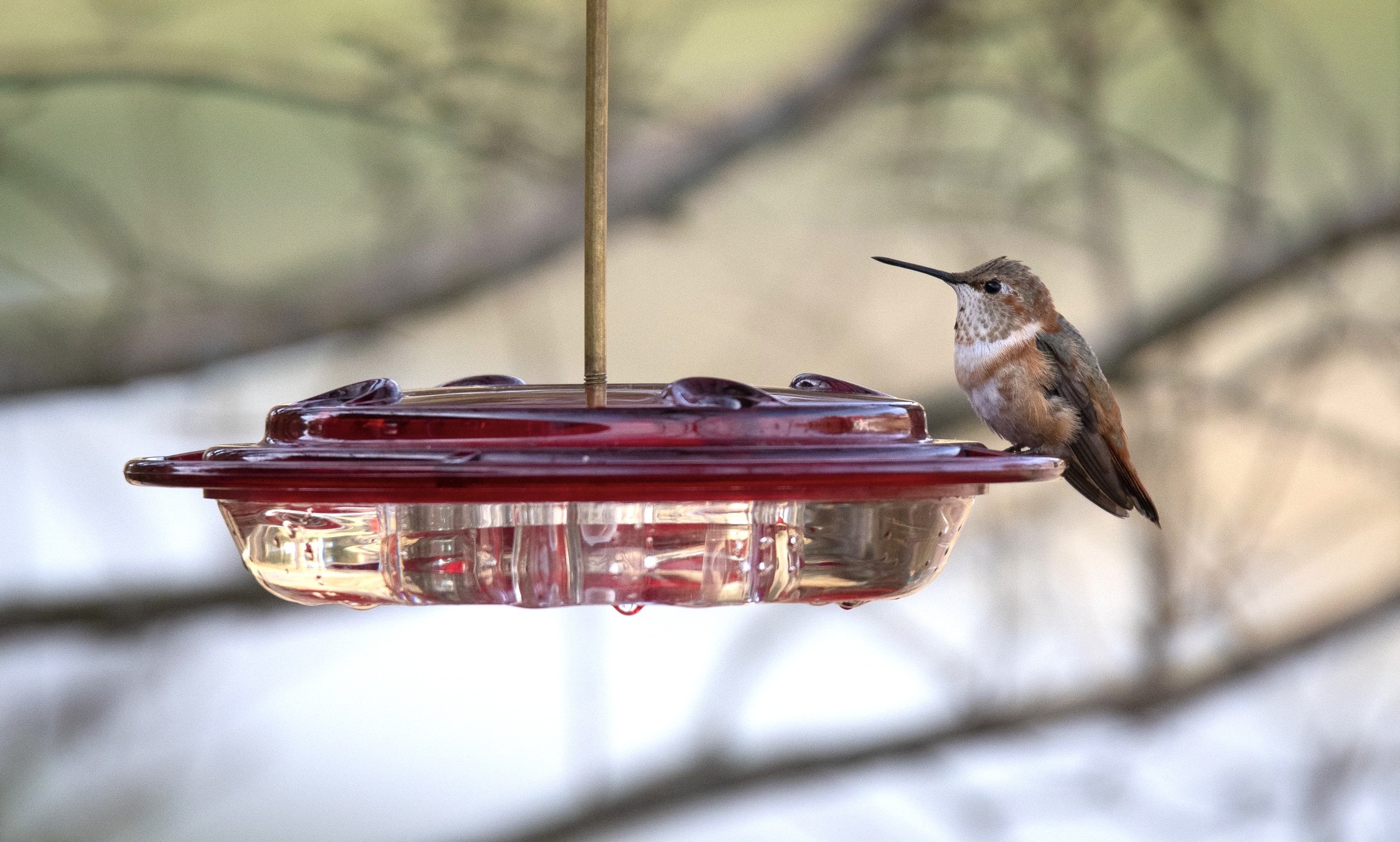
Remember, if you continue to offer a hummingbird feeder you may be one of a few people who get to see a wintering hummer, which most often is a western species known as the Rufous hummingbird.  I have continued to offer a feeder well into fall for many years but have not been successful thus far.  Maybe this will be my year. 

Wood Thrush Notes

Fall Migration and BIRDCAST

Fall Migration is underway and while your seed and suet feeders will typically slow down now through October, birdwatching in the area will be significantly more interesting because migration is in full swing.

When spending time outdoors have your binoculars with you and ready because Warblers, Tanagers, Orioles, Rose-breasted Grosbeaks, and Flycatchers are pouring through middle Tennessee stopping to feed in the mornings on insects and berries, and at birdbaths. Pay particular attention to birdbaths and fountains as many of these birds seek out good water sources to take advantage of.

Mornings are best to see lots of different species because most migrants are traveling at night. They settle down to rest and feed in the morning.

Look for large if not massive flocks of Chimney Swifts and Common Nighthawk in the evenings commonly seen in areas near downtown or where there is ample night lighting like high school football games.

BIRDCAST

Did you know that radar used to track weather systems is also used to track bird movements? I suggest you check out BirdCast at birdcast.info. BirdCast is a project of the Cornell Lab of Ornithology, Colorado State University, and the University of Massachusetts Amherst. BirdCast applies weather surveillance radar to gather information on the numbers, flight directions, speeds, and altitudes of birds aloft in order to expand the understanding of migratory bird movement. Just last night, Sept. 28, an estimated 956,000 birds flew over Davidson Co.! And that number will increase as we approach the usual strongest time of migration in the month of October. BirdCast has live migration alerts in real-time and even projects what species are most likely flying over us on a given night. Their findings have been eye-opening and very interesting, to say the least. To summarize all the interesting information provided by BirdCast would be impossible. I urge you to check out this site. Wonderful!

Wood Thrush Notes

End of Summer-Early Fall Notes

We have received more than a few calls recently regarding the very noticeable slowdown at feeders in recent weeks. The degree of slowdown may vary each year but without a doubt September and October are the two slowest bird feeding months of the year. My 28 years of tracking sales data backs this statement up. We always sell far less seed and suet during these two months. So why does it slow down?

There are two reasons why feeder activity slows down at this time. Feeder activity is at peak level during the breeding-nesting season, between the months of March and July. We get used to the abundance of birds visiting our feeders and many of us are filling feeders frequently, every other day if not more. While nesting and raising young birds take full advantage, but do not rely on our feeders. Raising young takes a tremendous amount of energy and rather than having to forage for food at greater distances they will increase their visits to feeders exponentially, thereby staying closer to the nest and their valuable offspring. And many of our feeder birds will nest twice per breeding season. So, the first reason for the slowdown is the breeding season for our year round and summer resident birds has long been over, for at least a month and a half. The need for “extra” food has passed.

The second reason is by the end of summer and beginning of fall plants are producing seeds, nuts, and fruit. Beneficial insects chocked with protein are still very much available. Instinctually, birds cannot pass up the abundance of natural foods and variety now available. Therefore, the feeders that were important to them in the spring and summer become less important now. With no young to attend to they have little to do but feed on what nature is offering and to cache food for later use. Sure, you will still get birds visiting your feeders but not like during the breeding season. This would also explain why we rarely see Rose-breasted Grosbeaks at our feeders in the fall on their return trip to the tropics, when they are such prominent feeder birds in spring. Natural food is everywhere and unless something occurs to prevent food production, like a drought, birds will gravitate to it before going to feeders.

As much as the business owner side of me hates to see the slowdown I also appreciate the opportunity to point out birds do not rely on or survive on our feeders, as many people mistakenly believe.

Experience says by mid-November, or earlier if there are a couple of good frosts, you will see a return to busy feeders. So, don’t think something has happened to our birds. It really is just birds being wild animals acting on thousands of years of instinct. They will return to your feeders. By the way, this slowdown is a great opportunity to give your feeders a thorough cleaning.

Molting

Have you been finding feathers around your yard, or maybe seen some really funky looking Cardinals or Bluejays recently? Seeing Cardinals or Jays with an alarming lack of feathers on their heads is quite common after the breeding season.

Molting is the process by which birds lose damaged or worn out feathers with new ones providing them not only with healthy new feathers but often a new look to their plumage in the form of new colors or patterns that may indicate a bird’s age, sex, or season of the year.  Feathers are comparable to our hair or nails made from the same basic ingredient, keratin.  

Molt is not a “one size fits all” occurrence.  There is great variation by species and even by individual from year to year.  While molt is associated with this time of year any time a bird loses a feather a new one will immediately begin to grow in its place. 

Occasionally, Cardinals and Bluejays will lose all their head feathers in a short amount of time and while it takes a while for the new ones to grow in the result will be a bald bird.  I’ve seen a number of male Cardinals recently that were in between bald and the emergence of new feathers.  They look rather odd as their heads under the feathers are dark gray to black.

Molting Cardinal

Hummingbirds Getting Plump

I’ve seen some chubby hummers at the feeders lately as they continue to feed heavily and store fat for their long journey.  There’s plenty of time remaining to enjoy hummingbirds as they prepare for their return to Central and South America.  While you may have already seen a reduction in numbers of hummers at your feeders keep in mind Ruby-throated hummingbirds continue to head south from as far as Canada.  These very birds may show up at your feeders at some point weeks from now so keep the fresh nectar coming and your feeders clean.  Earlier in September I was in Maine and had several sightings of hummingbirds.  Isn’t it amazing when you consider the distance traveled by these little dynamos?